Picture of Piero L. S. Folly

Piero L. S. Folly

Game Designer | 3D Environment | Technical Artist

F.A.M-E.D. | Fire AgeDungeoneers

Role: Game Designer
     Responsibilities:

  • Research: Creative Concept, GDD, Design & Balance
  • Development: Loops, Systems, Economy, and Databases
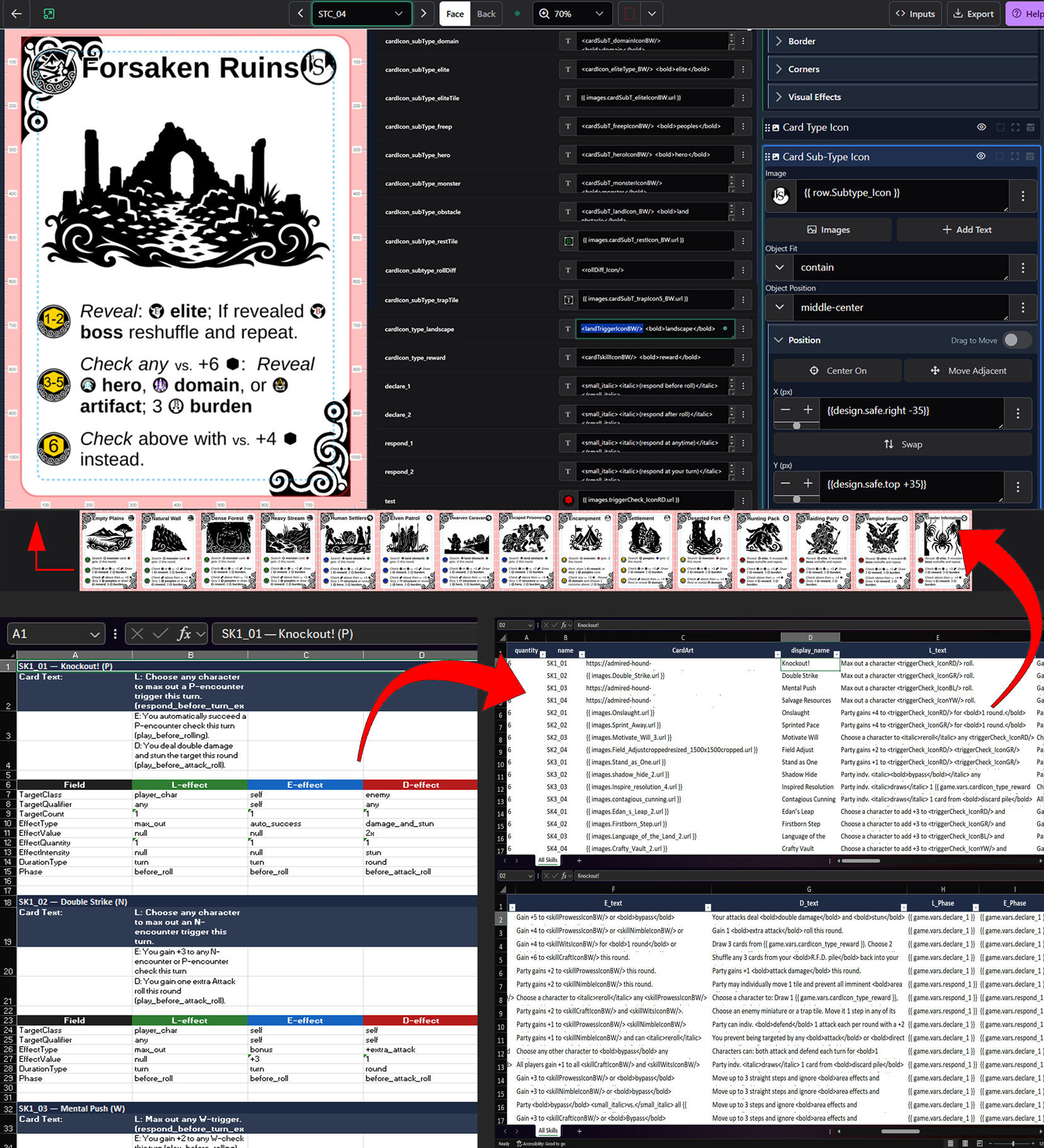
  • Production: Prototyping, Asset Art & Engine Implementation
Process Breakdown

Iterations Overview

Inspirations & Aspirations

Objective: 
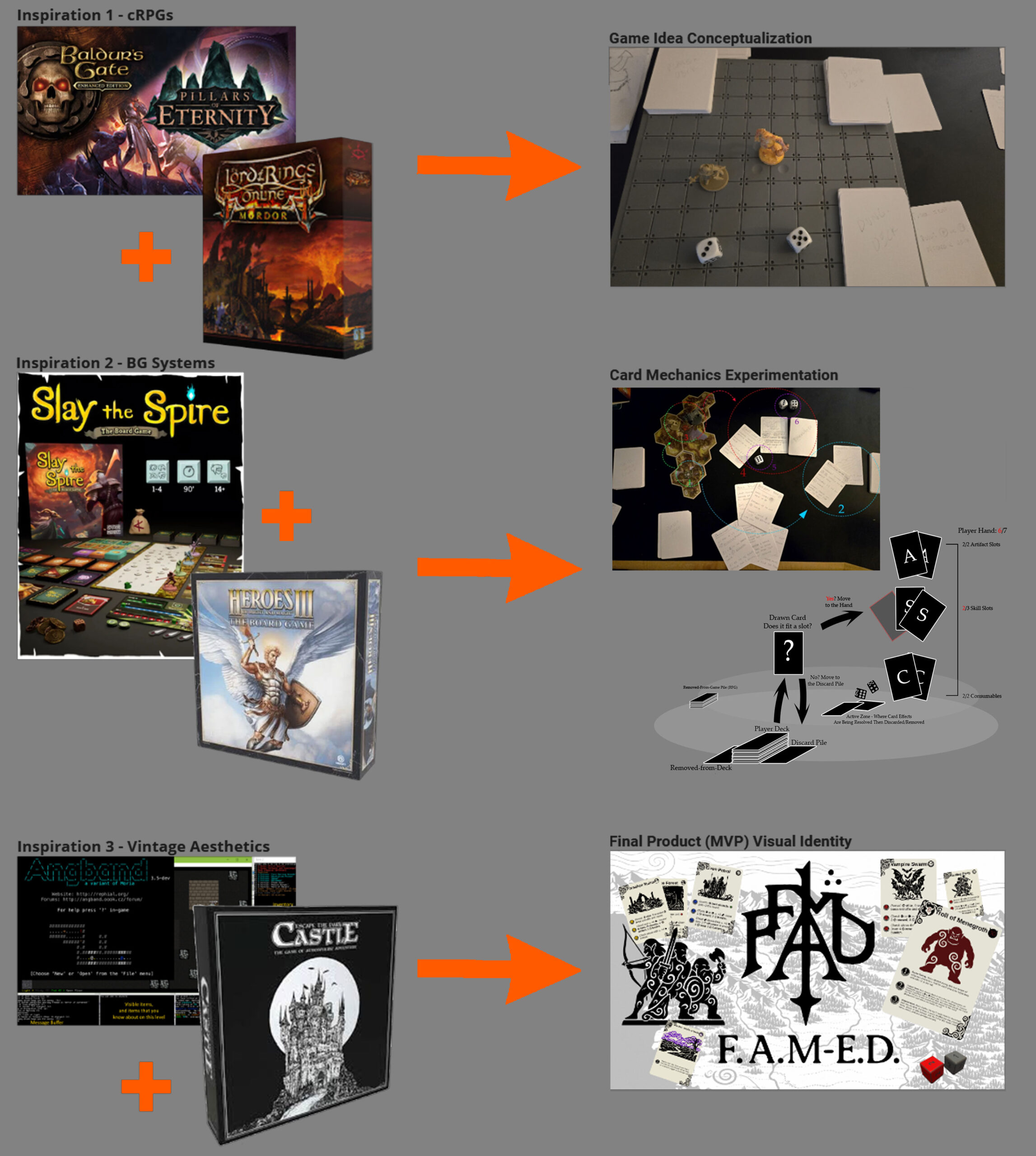
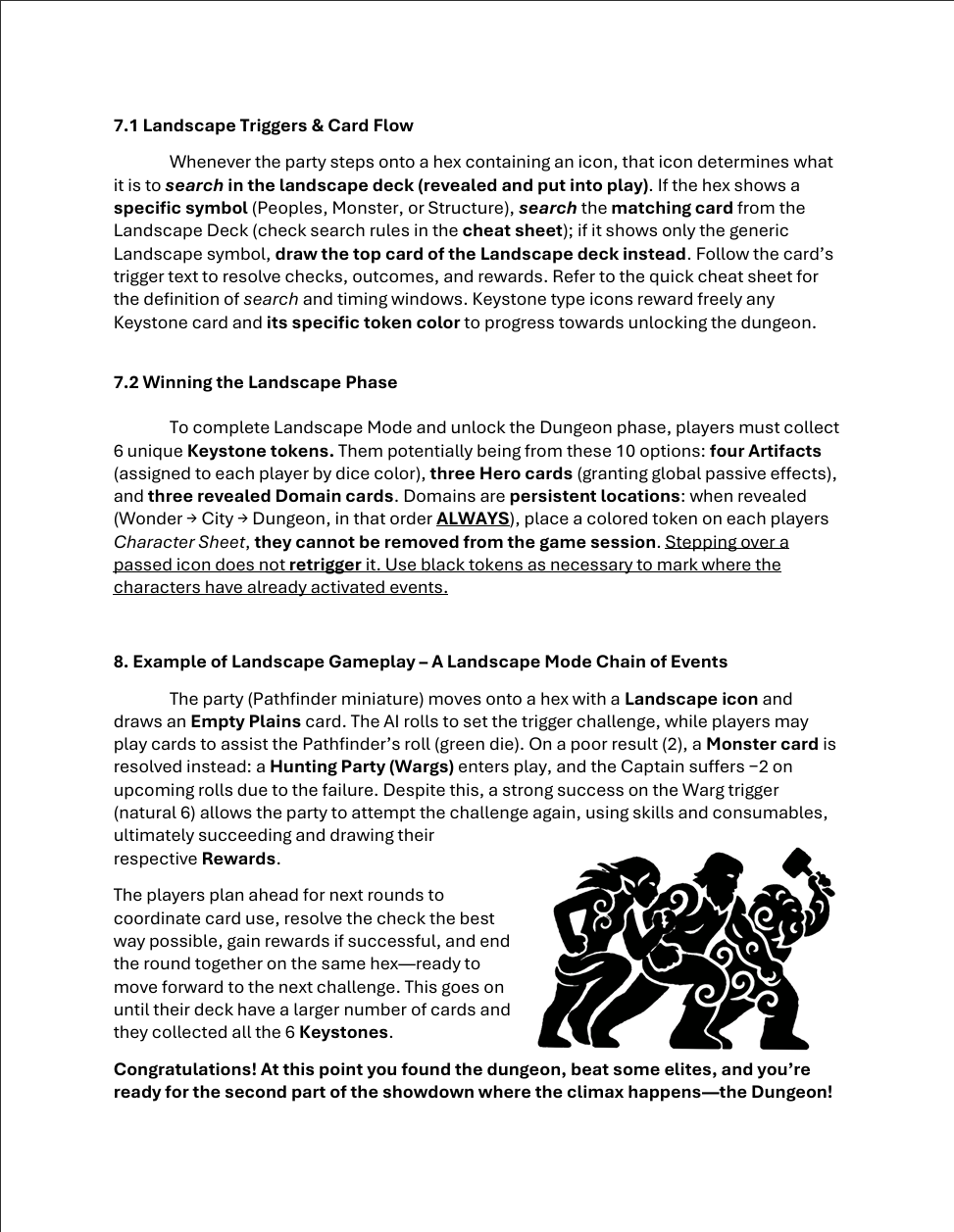
This game aims to evoke the feeling of combat journeymanship and world adventure throughout Main-Eterra’s landscapes in its earliest concepts and forms during its Fire Age—inspired by Middle-earth-like scenarios—while aiming to tell a story mimicking modern cRPG-style systems, such as those found in LOTRO, Baldur’s Gate II, Pillars of Eternity, Slay the Spire, and similar titles, yet mixing and adapting to the constraints of board-game mechanics. The prototype focus on vintage aesthetics, such as ASCII games and B&W board games while revolving around 3 core gameplay loops designed to motivate player engagement:
  • Individual deck-building: The primary player motivation, driving engagement through progression & player agency via character power growth.
  • Co-op map exploration: The secondary motivation, fueled by narrative desire & team usefulness; both fulfilled via teamwork to unlock more story content and game rewards.
  • Climactic dungeon crawl & combat: The tertiary motivation is the proof of mastery—that happens during the final showdown of the session! Players demonstrate feats and coordination by defeating the dungeon’s challenge in a boss fight without letting their characters die.
Throughout this 12-week process, I sought regular professional feedback from Jeremiah Franczyk (System & Content Designer on LOTRO — The Lord of the Rings Online), who helped me better understand how different designs, mechanics, and balance considerations could be applied to this game.

Overview & Technique Highlights

Game Premise: Set in the waning years of the early Fire Age, a fellowship of four Dungeoneers—prowess warriors, nimble wanderers, witful scholars, and crafty treasure-seekers—hear a call to explore ancient ruins, hidden cities, and the land of Valouki to expel the lingering shadow of the ultimate nemesis of the world, the Dark Lord Bauglor.
While most of his malevolent hosts remain hidden within the besieged fortress of Bandangath in the far north of Main-Eterra, his corruptions spreads and the great events of this era unfold beyond your eye.

Forge your own path in this mythical quest, when angelic beings walked among us, the Elves were young, the Dwarves carved their first halls, and the sons of Men had only just awakened. Venture forth not only for glory, but to heal and preserve what light remains for future generations.

Technique Highlight 1 | The Deck-building & Rolling Systems

Goal: 
The first gameplay challenge I wanted to address was the core of the game: the benefits of cooperation between players in overcoming challenges, without removing their sense of individual agency or independent power growth.
Result: 
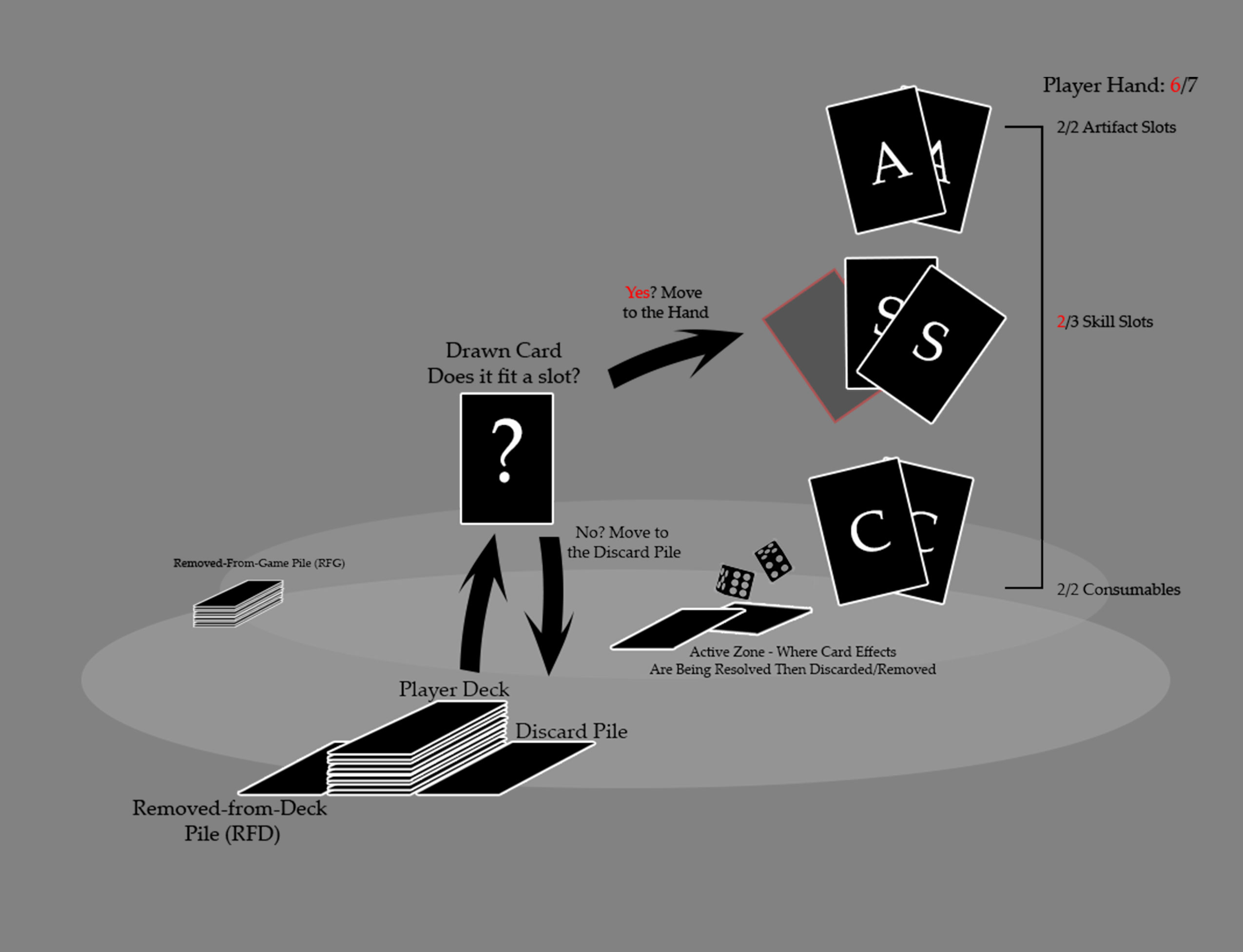
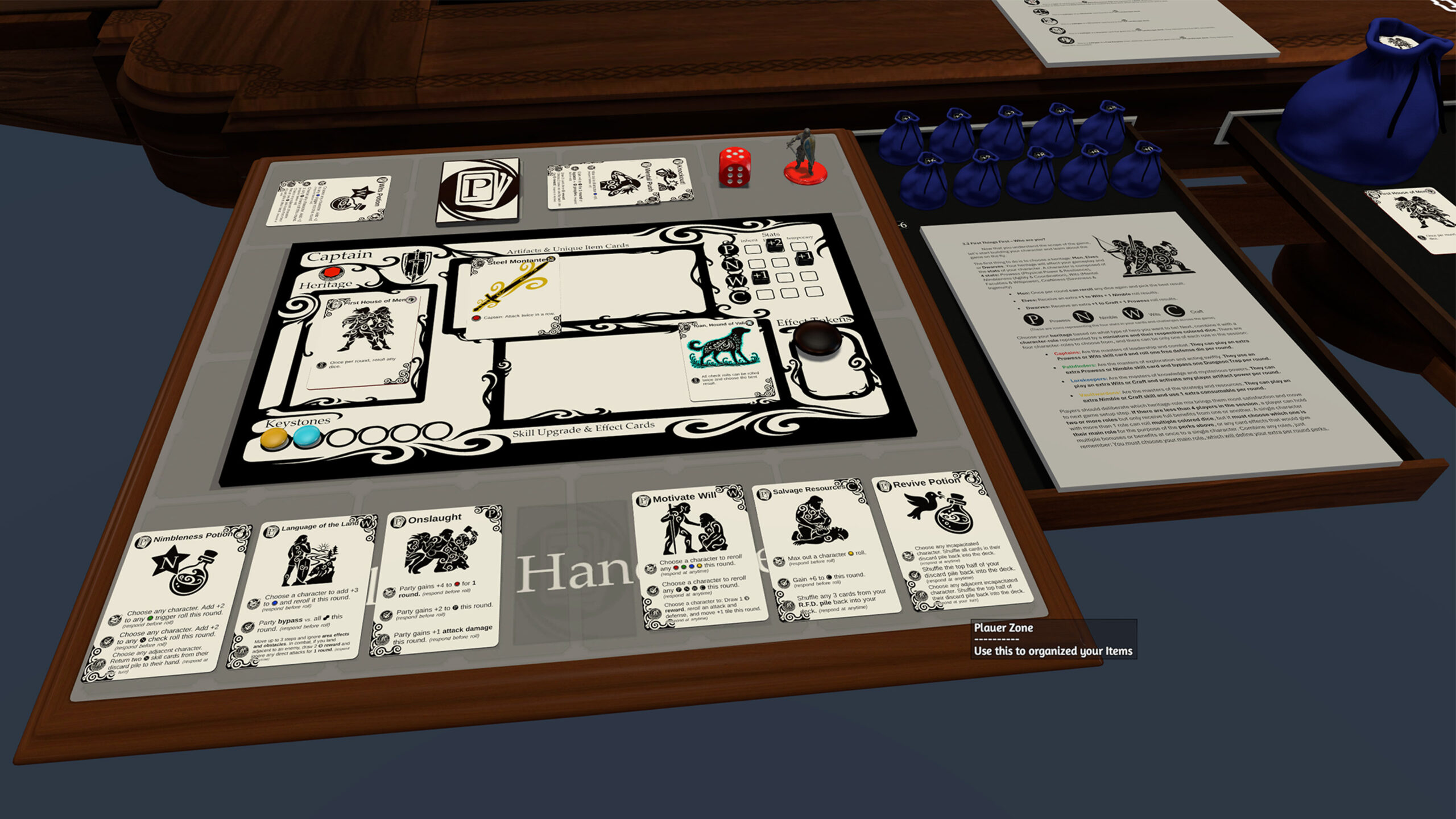
I created a deck-building system to encourage coordination through rewards and complementary actions, while keeping independent player decisions relevant through control over personal decks. Teamwork improves outcomes, while individual play remains meaningful as each character’s deck power grows.
Techniques:
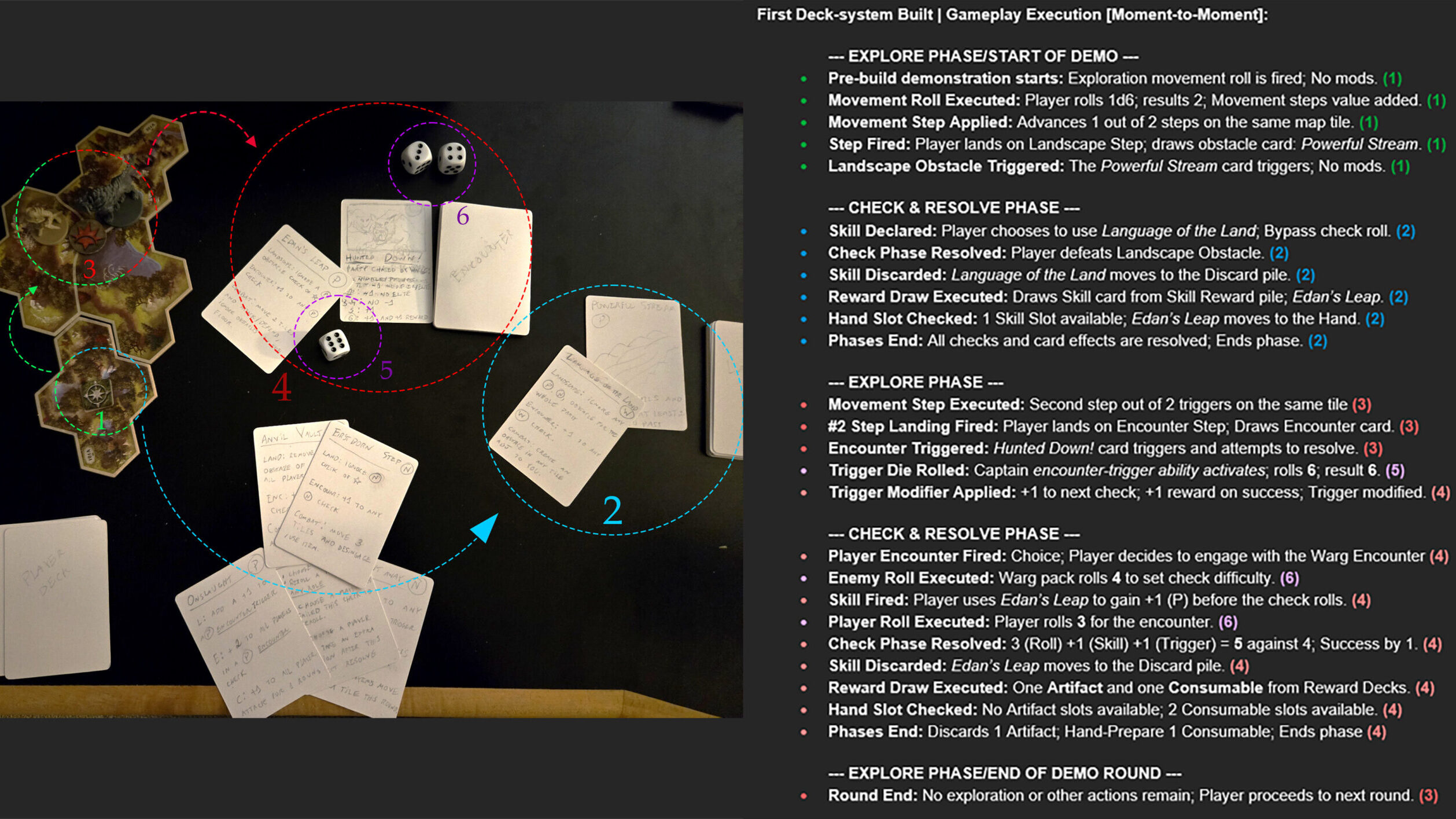
  • Card+Dice: Characters and AI use a dice–deck combo to define system limits.
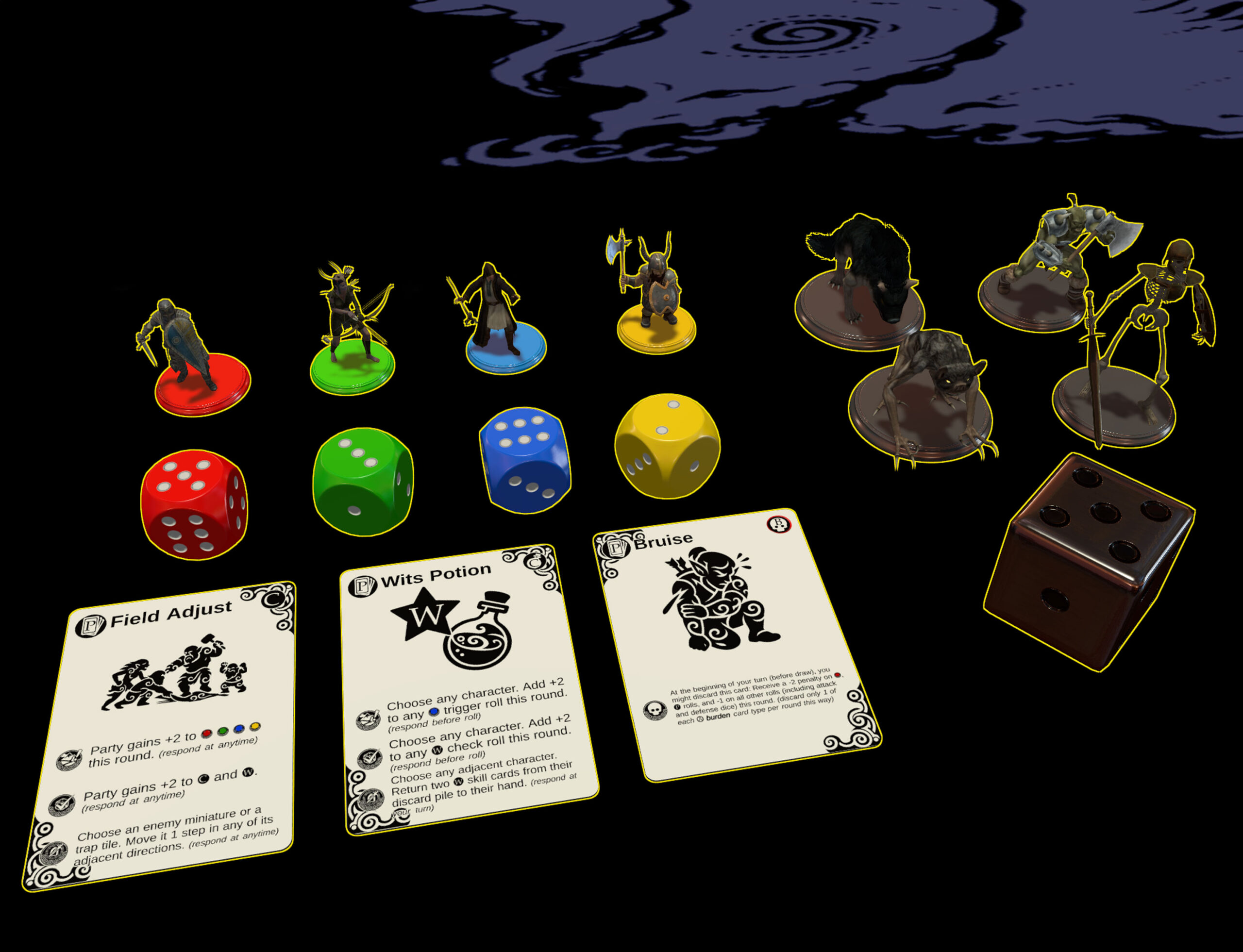
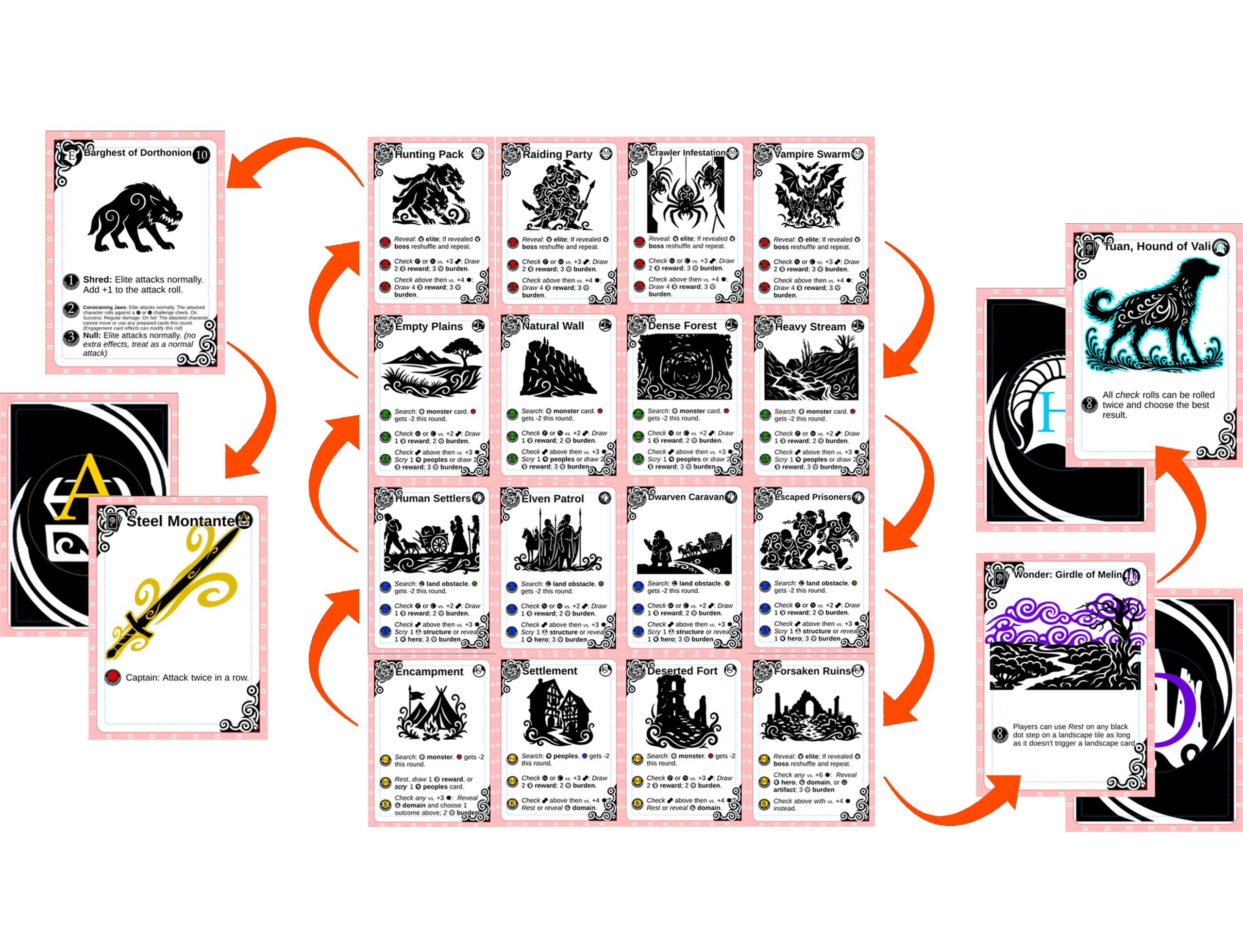
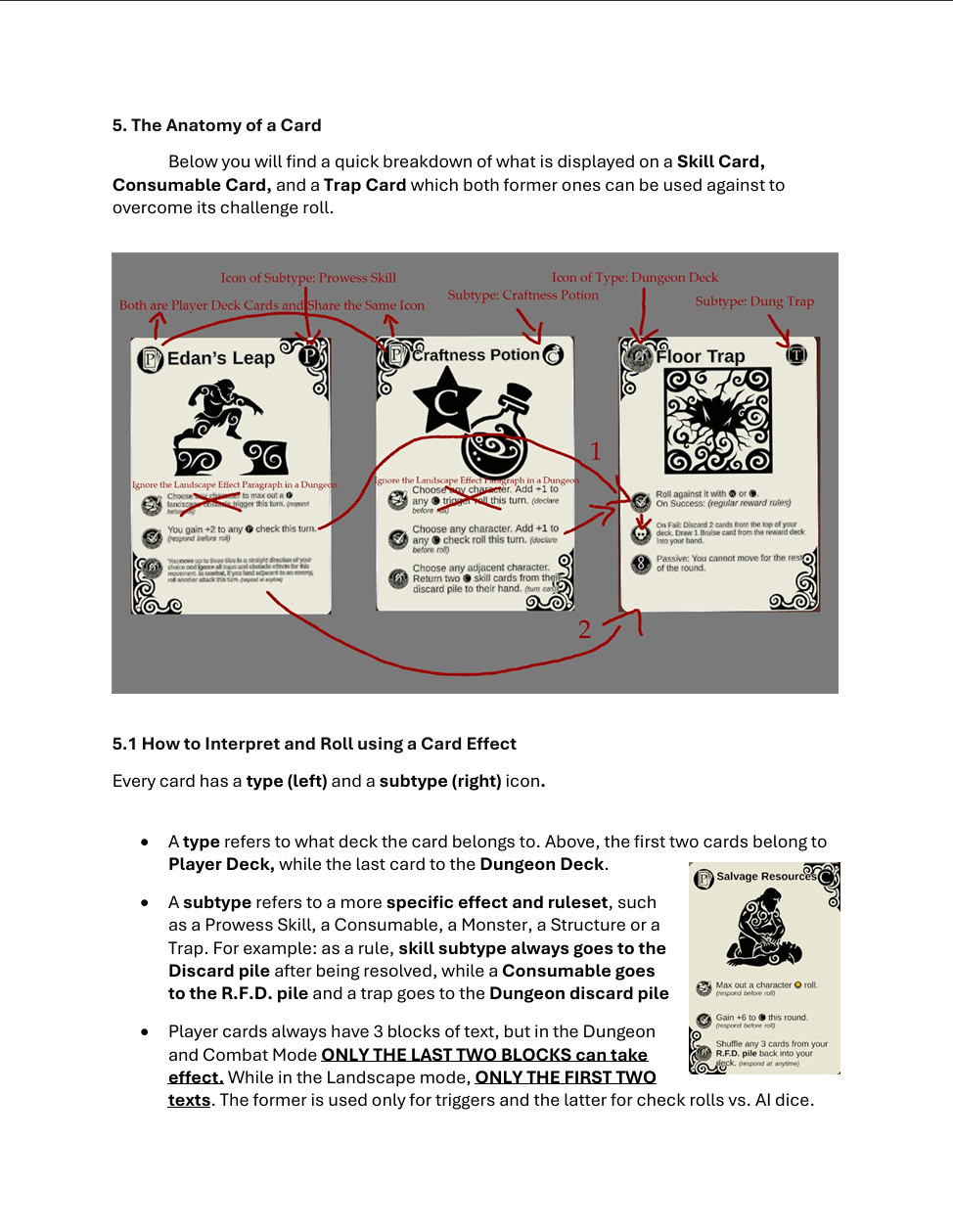
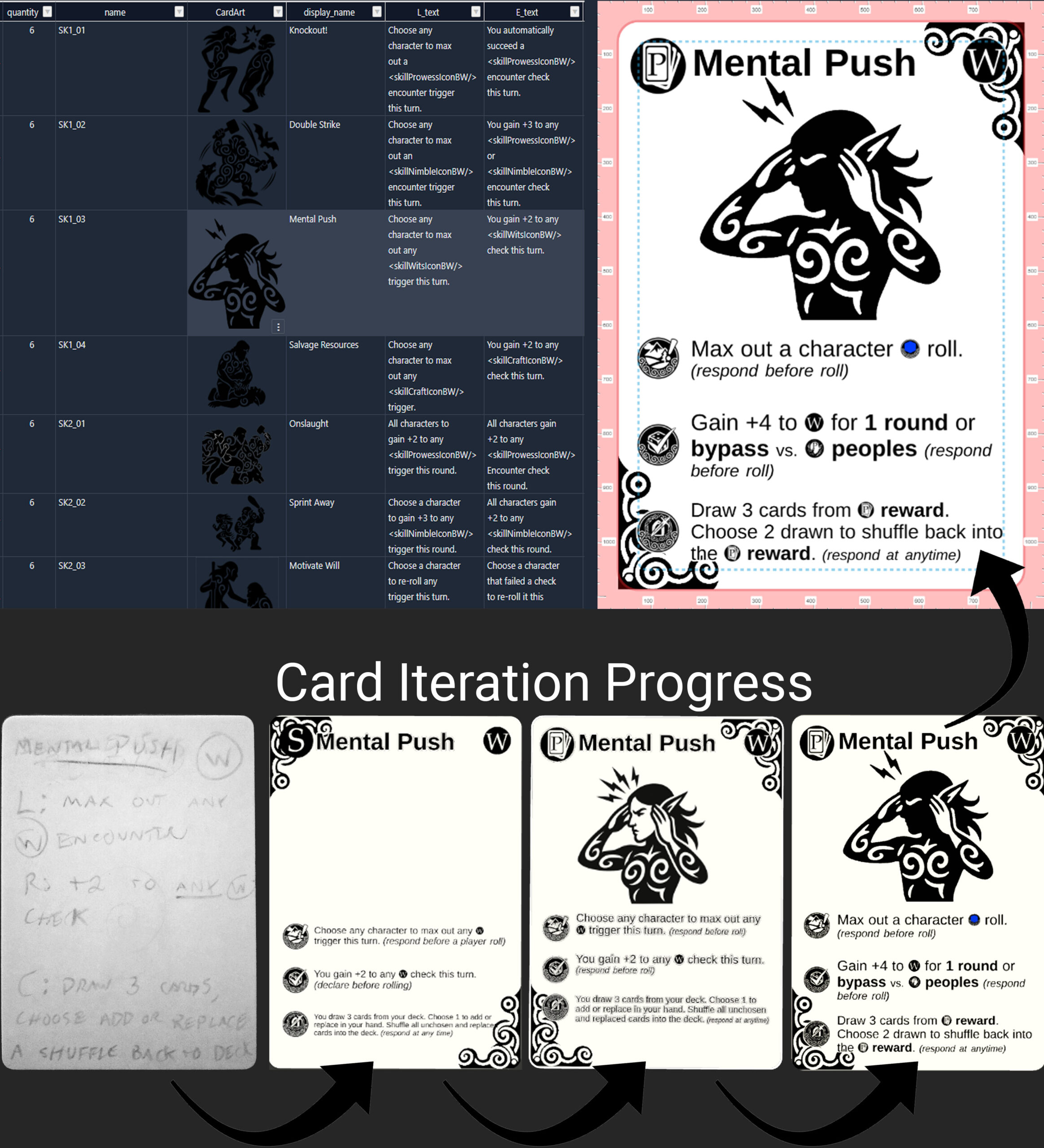
  • 3 Text Types: Cards contain three text blocks designed for different gameplay situations: landscape triggers, check vs. challenge, and combat.
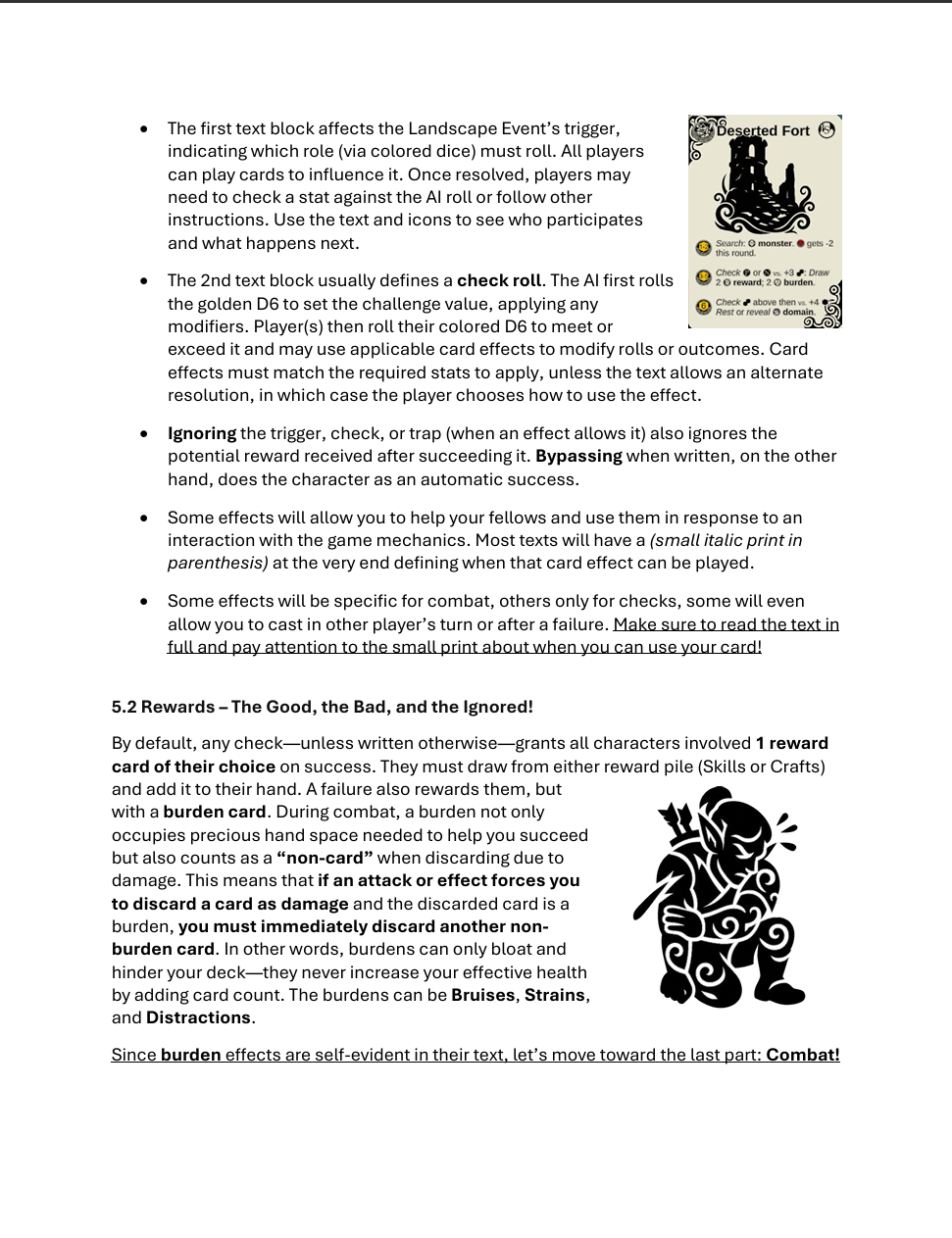
  • Effect vs Rolls: Card effects are dice-rolled and chosen from text, affecting the party, a single target, and/or lasting multiple rounds. Some help, others hinder.
  • Deck Cycling: The deck logic does not punish early card usage, since most of the discard pile recycles back into the deck later, with rule constraints.
  • Multi-card Rules: Player cards have separate rulesets—skills, artifacts, and
    consumables—representing power tiers. AI decks—dungeons, events, and
    combat
    —are also split similarly, establishing layered challenges.

Technique Highlight 2 | Dungeons: Generative Movement & Combat

Goal: 
The second challenge I addressed early on was the combat and dungeon system. I aimed to make it not only challenging and fun, but also innovative, while mimicking the randomness of combat and dungeon exploration in each session.
Result: 
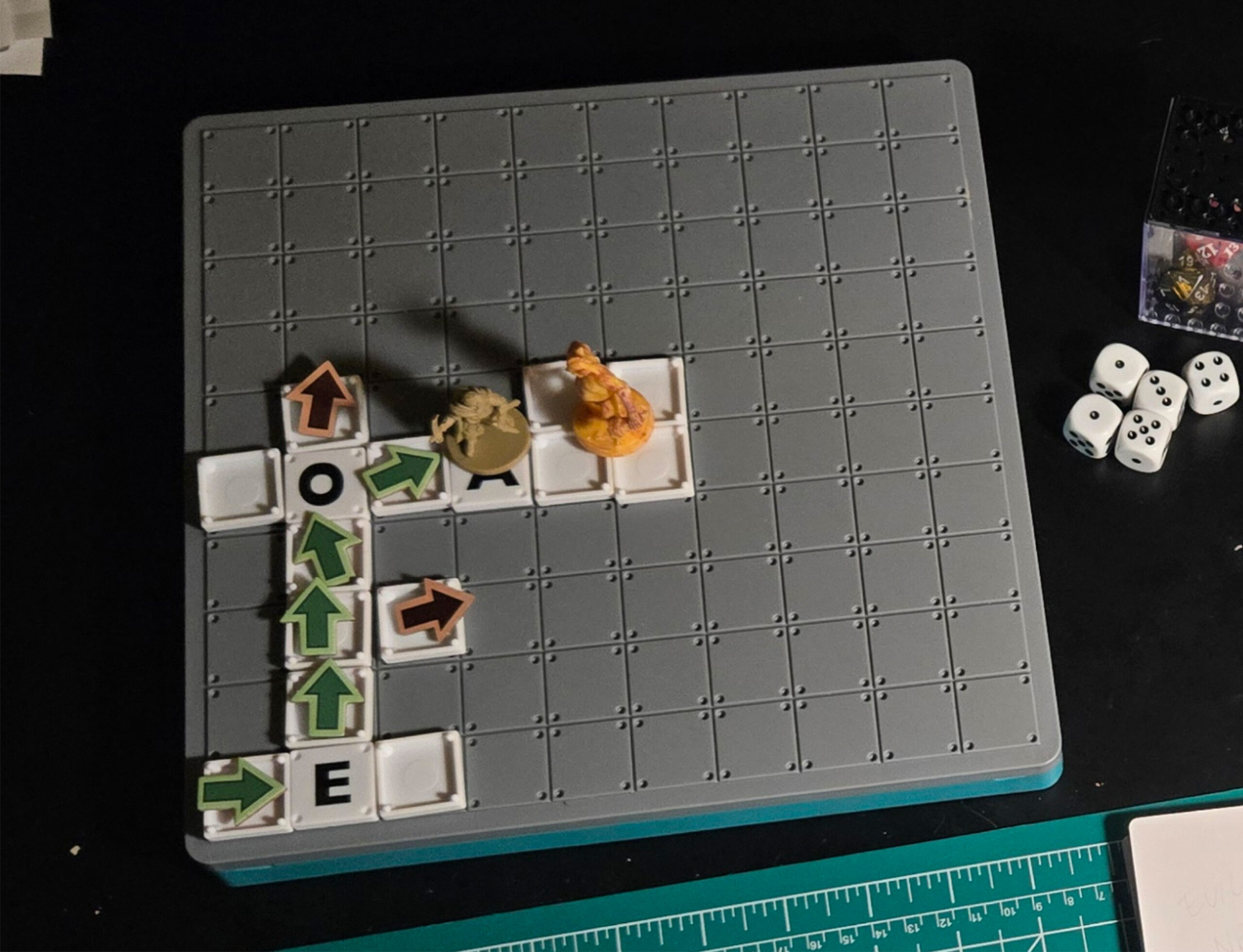
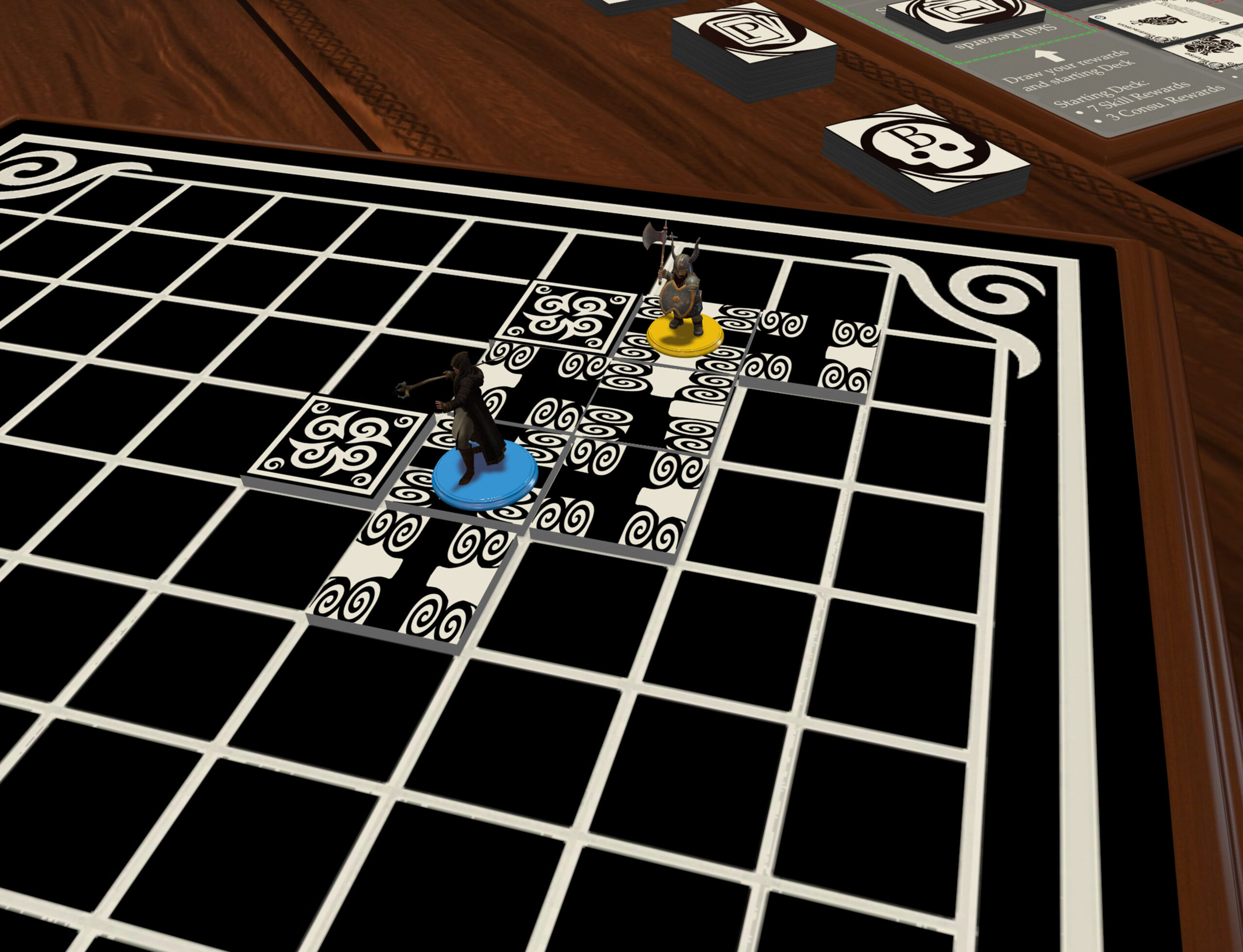
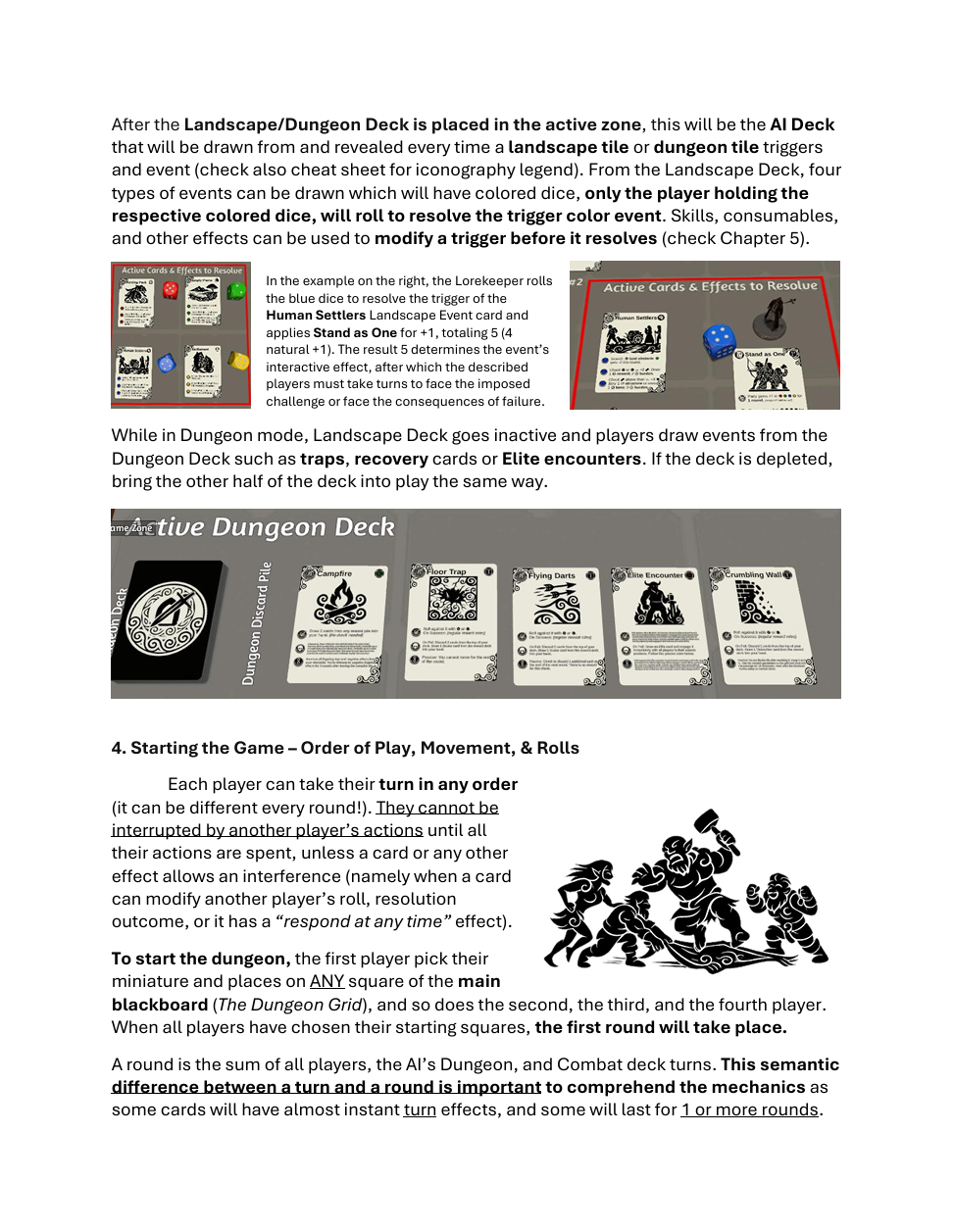
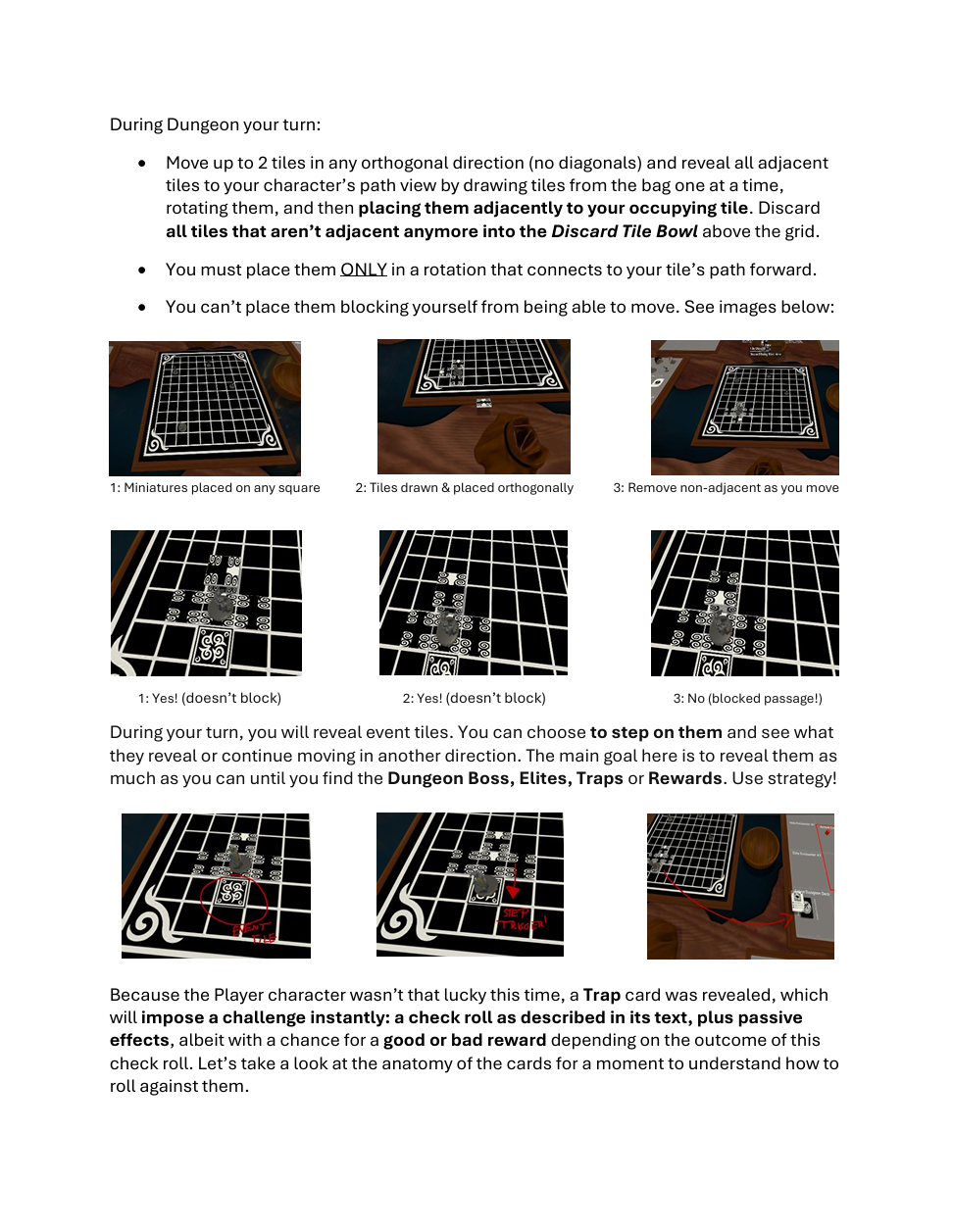
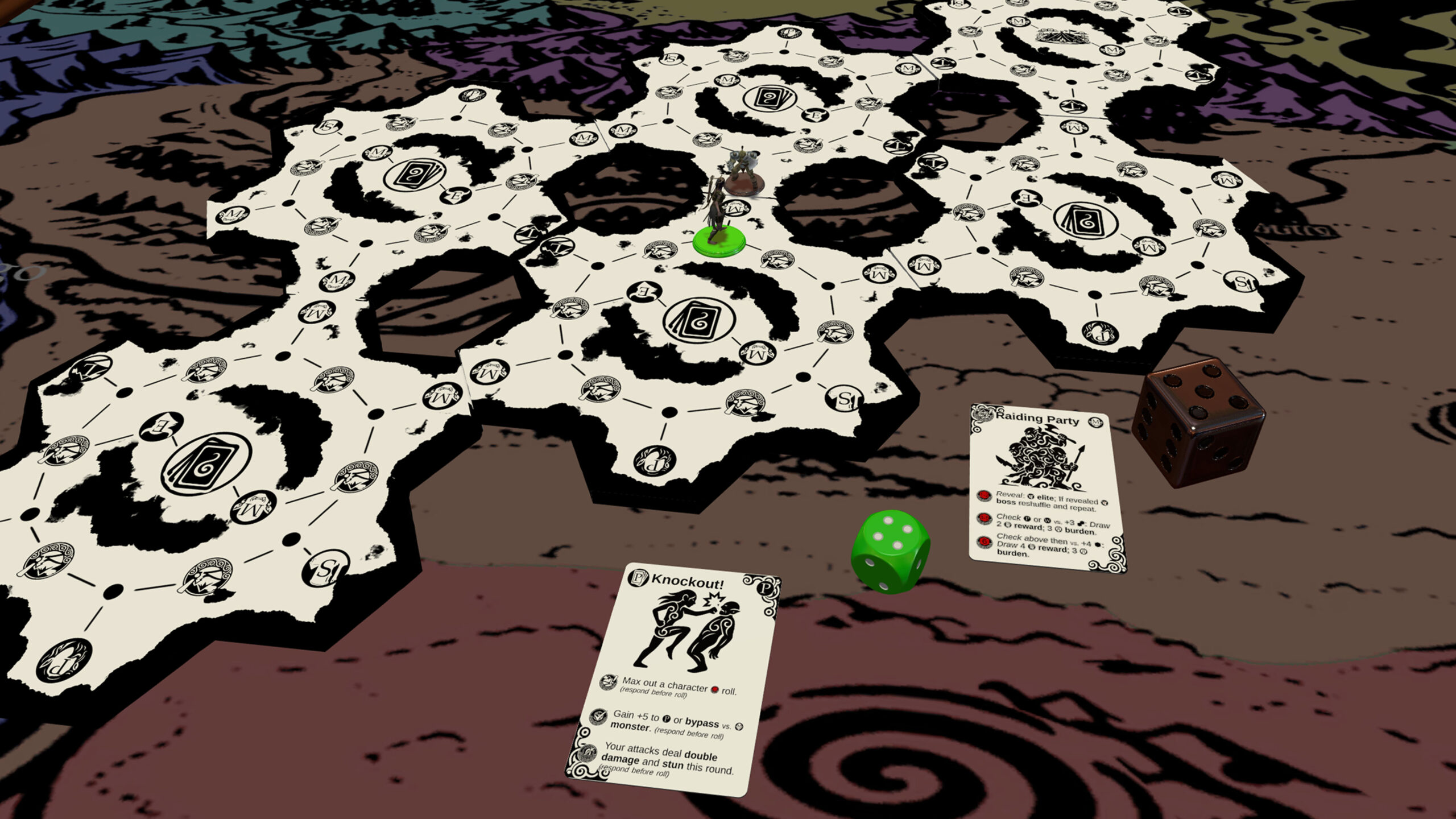
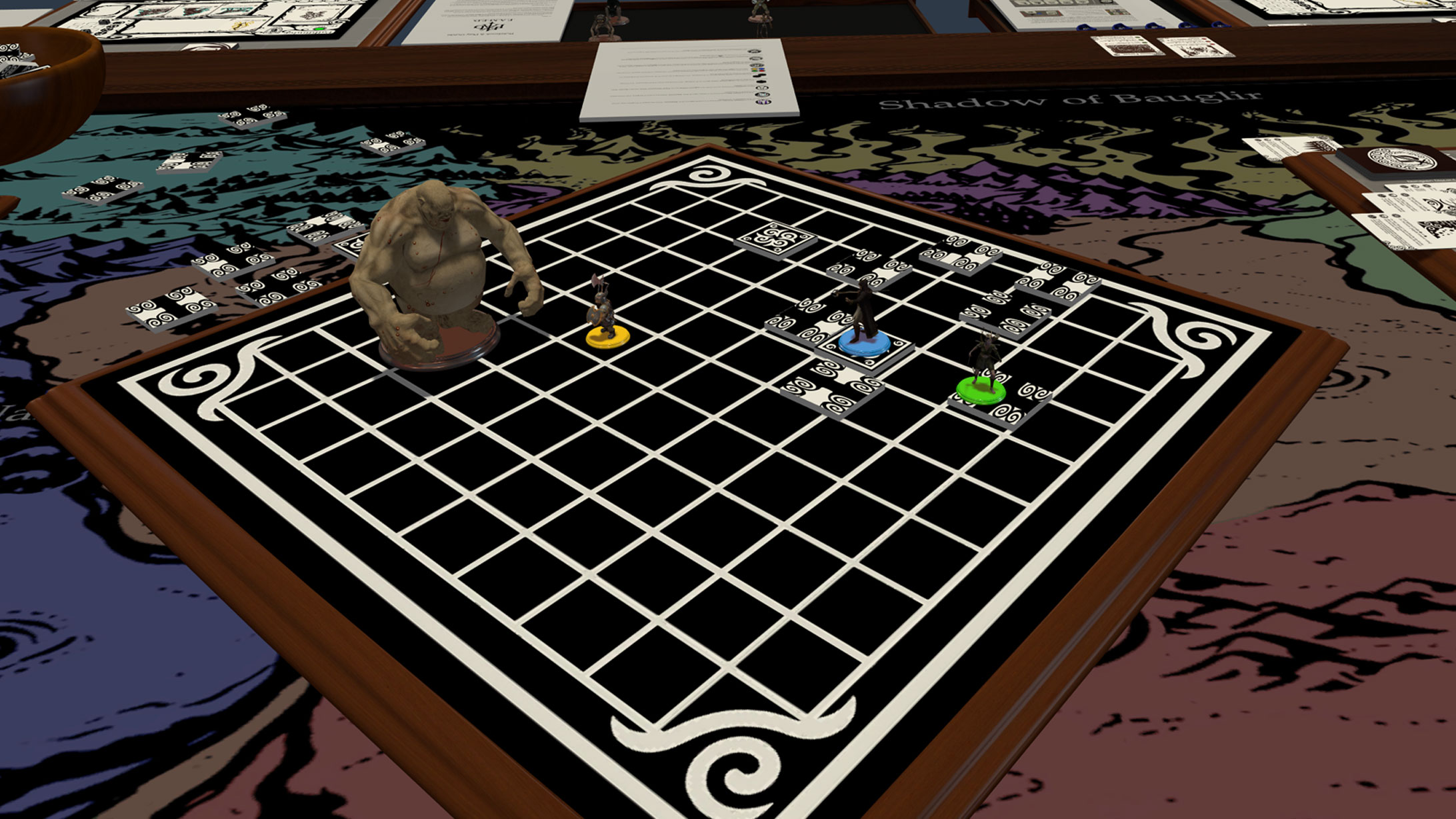
A grid-like movement system to support the sense of individual moment-to-moment play and randomness of interactions through procedurally generated movement tiles across the board. Players dungeon-crawl, overcome unexpected traps, encounters, events, and ultimately find the final Boss to fight.
Techniques:
  • Procedural Tile Draw: Movement tiles and events are dynamically drawn, with varying grid layouts and interactions to support exploration and uncertainty.
  • Everchanging Paths: Tiles are removed and added each time a player moves across the board. Paths are never the same, even when backtracking.
  • Luck-of-the-Draw: Event tiles can be drawn at any moment during
    dungeon progression, revealing cards of traps, monsters, helpers, or the endgame goal—the Boss. Hopefully not too late or too soon!
  • Tile-Deck Synergy: Building on top of the deck systems, the movement
    and event tiles work in tandem with two AI decks: Dungeon and Elite Combat.
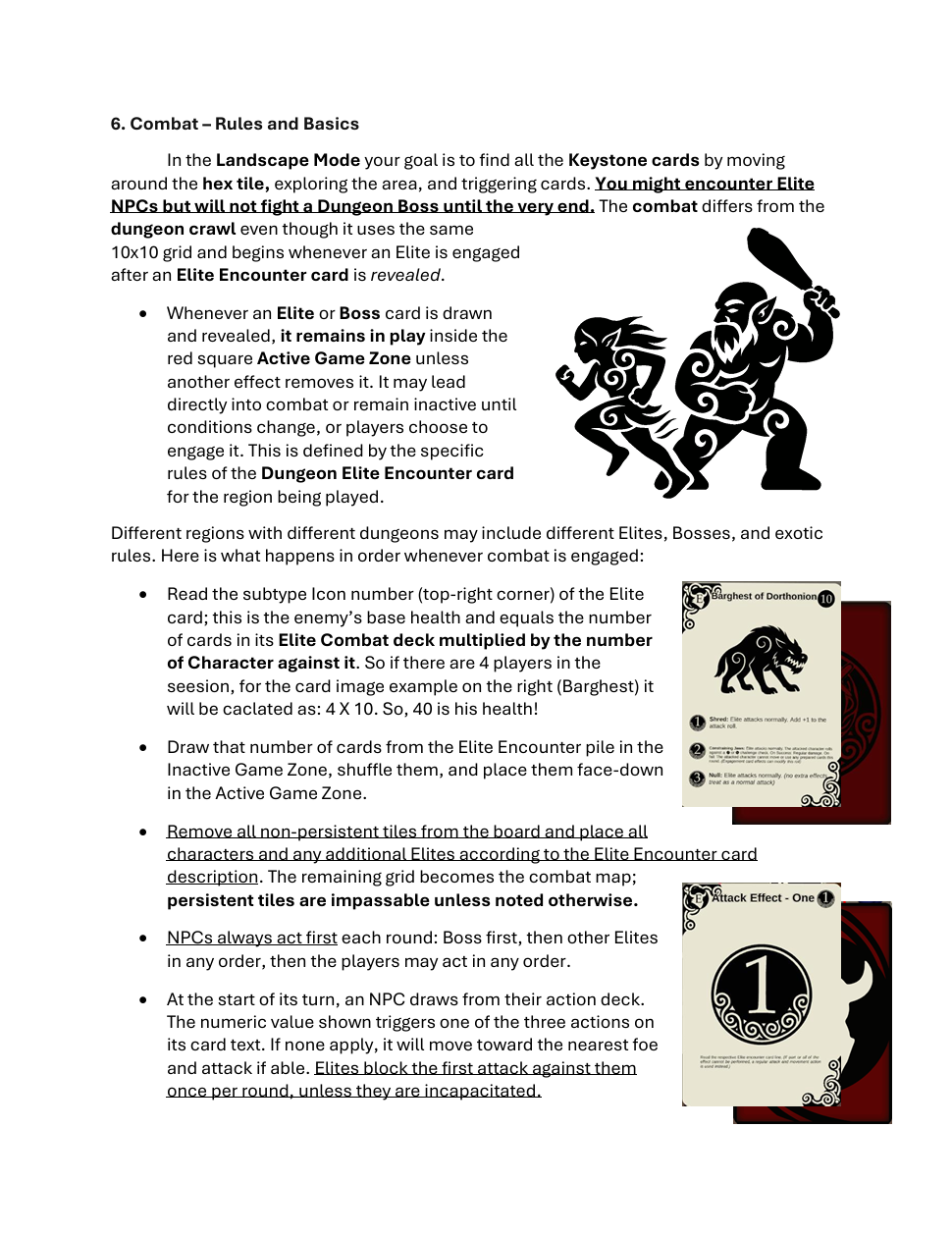
  • Fight = Change: Combat mode further alters player interaction compared
    to Dungeon and Landscape modes, introducing higher risk and reward.

Technique Highlight 3 | The Landscape: Exploration & Interaction System

Goal: 
With the game mechanics entry and endpoint defined via dungeon, player deck, and combat systems, the challenge was to shape the connective layer between them: the landscape and map system. I needed to define how player choices through exploration would progressively lead to the session’s climax, the Dungeon!
Result: 
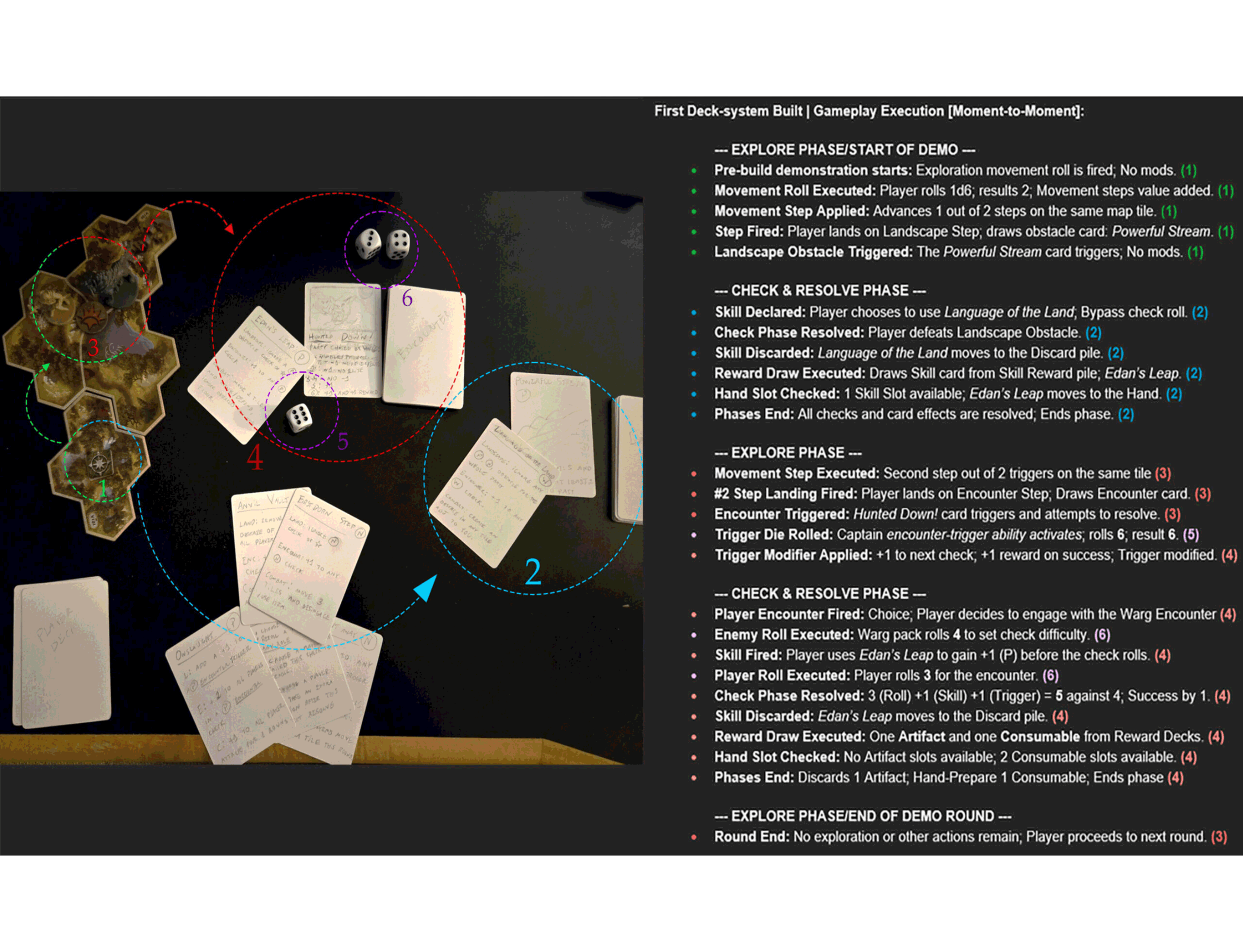
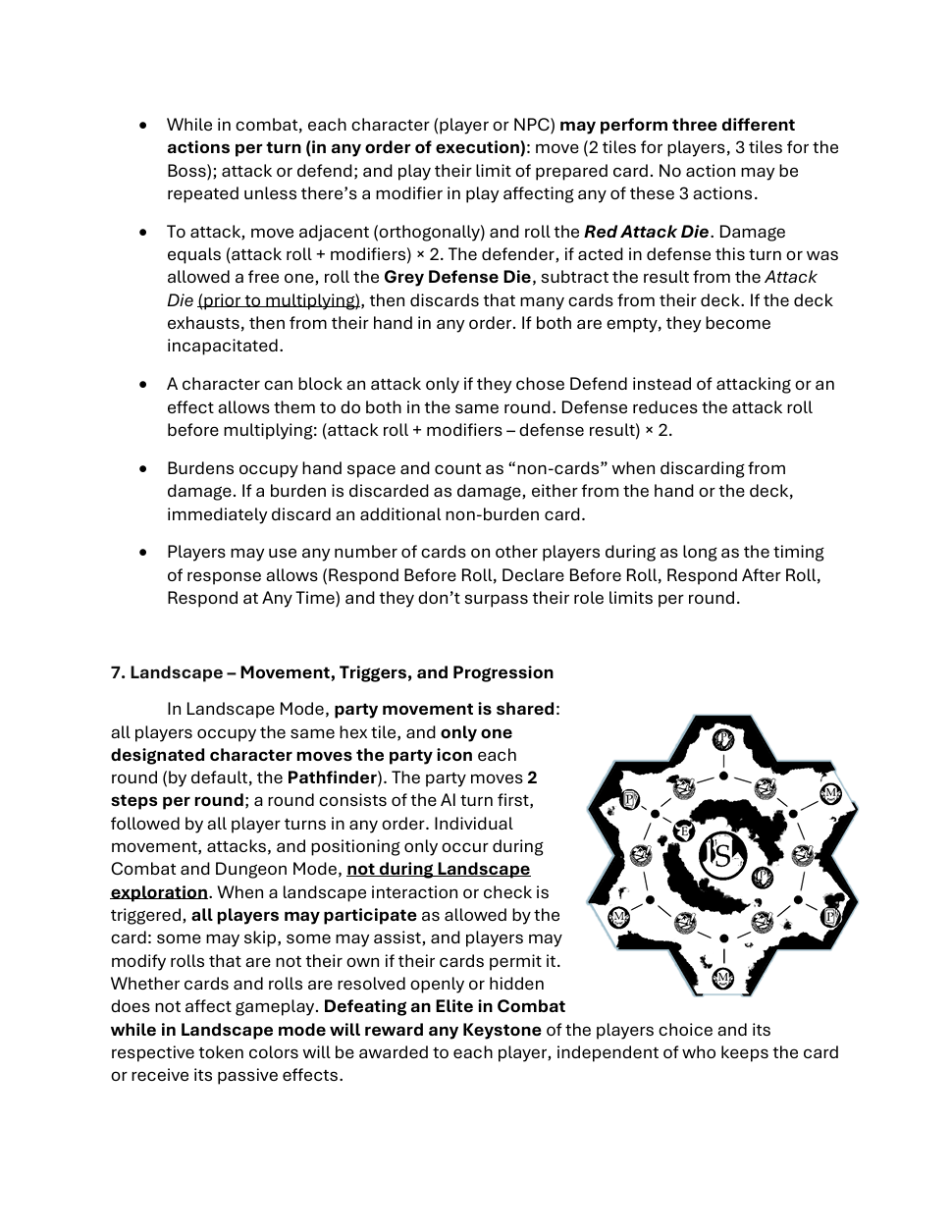
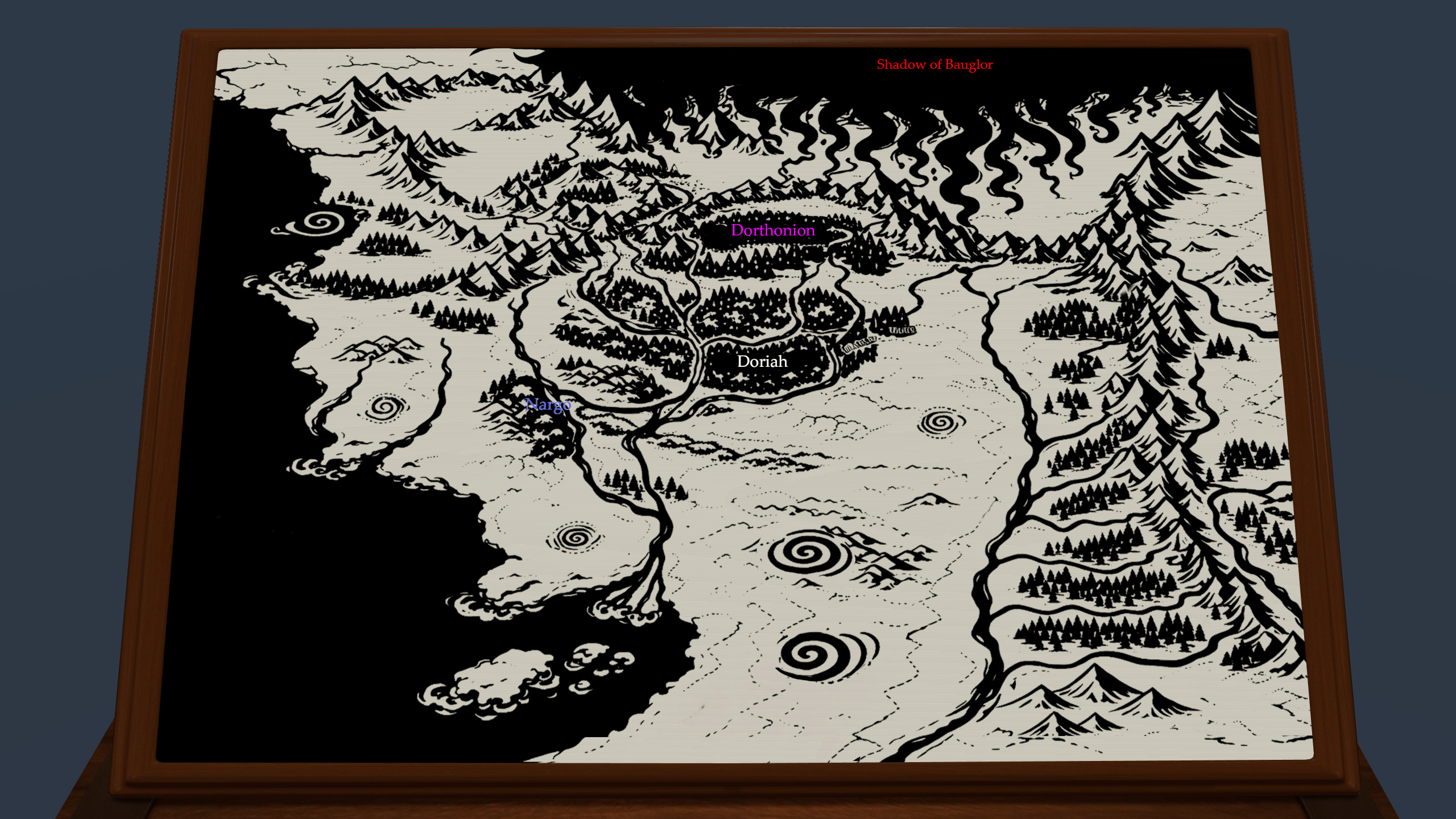
I designed a hex-based movement system where player roles drive landscape events. Each role governs an interaction type, while different Landscape Event cards introduce tiered challenges that chain outcomes through what I called Keystones, guiding players toward the goal.
Techinques:
  • Role-driven Exploration: Each player’s role governs a specific interaction on landscape, clearly defining responsibility and player identity during exploration.
  • Player Party Movement: The party moves as a unit across a hex grid, with role ownership determining how paths, risks, and progression are resolved.
  • Landscape Event Deck: Events introduce exploration challenges tied to roles and the stats economy, rather than relying on random outcomes alone.
  • Tiered Challenge Structure: The landscape event card system is organized by difficulty tiers, scaling tension and consequences as the party advances.
  • Keystone Chain Effect: Certain rewards act as keystones, progressively increasing the speed at which players unlock the dungeon entry.

Process Breakdown

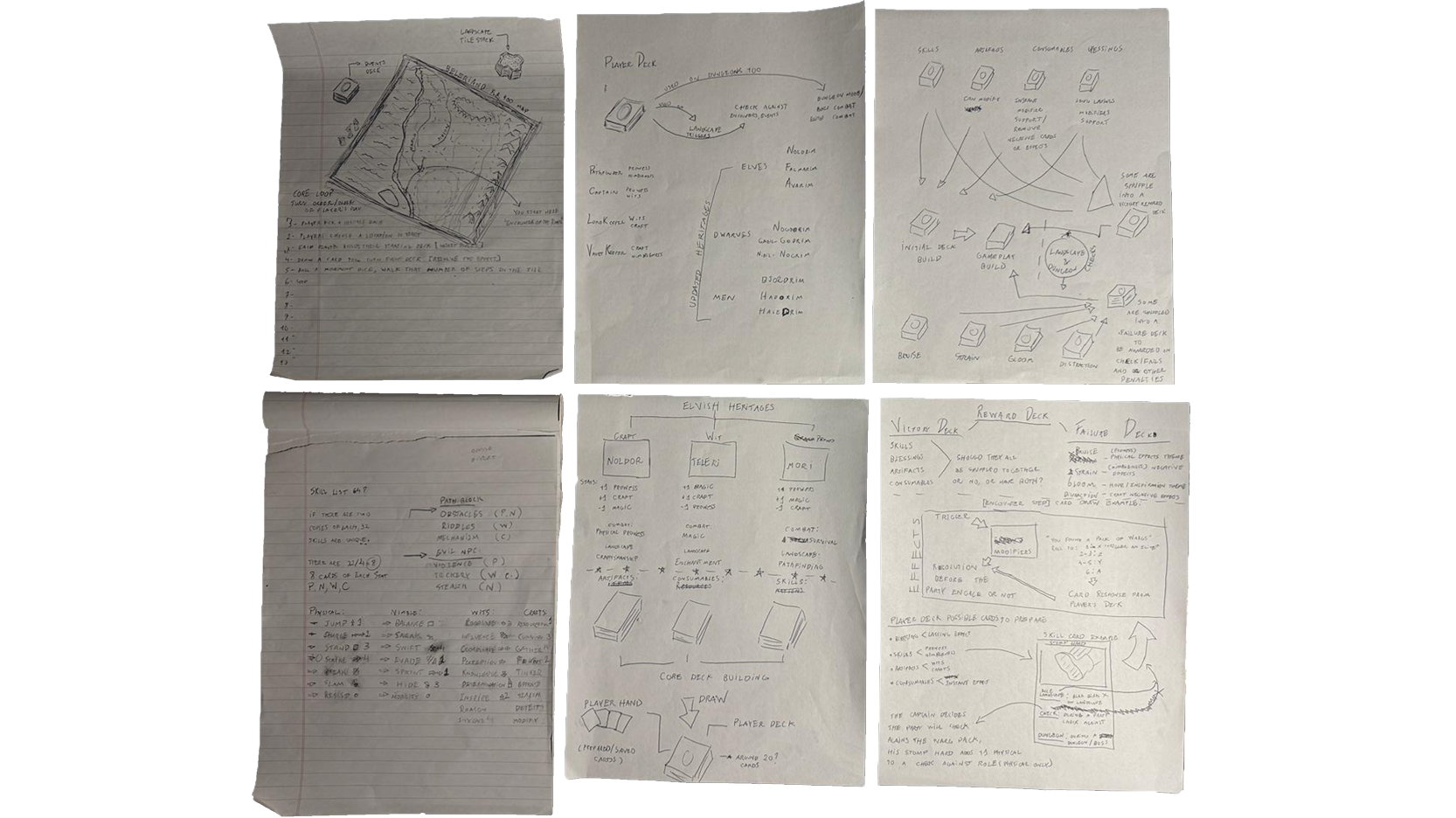
1. Research, Ideation & Planning

Main-Eterra Logo Design

Theming it around what I’m passionate about—Tolkien’s Legendarium—I drew inspiration from The Silmarillion and his early writings to create Main-Eterra. The narrative imagined in this tabletop format condenses short quests, tile-based exploration, and brief dungeon-instance challenges where players defeat bosses, grow their heroes’ decks, and advance the story further. It aims to welcome both casual and seasoned players with a 30-minute run time and iterative multi-session play options where progress can be carried over.

  • Analyzing Games: HOMM3: map-tile exploration; Slay the Spire: deck logic; Journeys in Middle-earth: co-op structure; Tiny Epic Dungeons encounter dynamics; LOTRO role synergy, quest flow, and land/instance rhythm.
  • Ideating Mechanics: Deck growth with questlines; tile-based co-op exploration; challenging individual encounter choices with check rolls. They seem to have the potentital to encapsulate larger, complex mechanics in a simple way of both computer and board games that I want the players to experience.
  • Resonant Theming: Heritage, roles & stat mechanics to choose from along other mythical fantasy nomenclatural elements such as “quests,” “orcs,” and “artifacts,” as seen in Middle-earth, D&D, and other similar RPG genres for games, entertainment, and visual arts.

2: Design Document - Rulebook

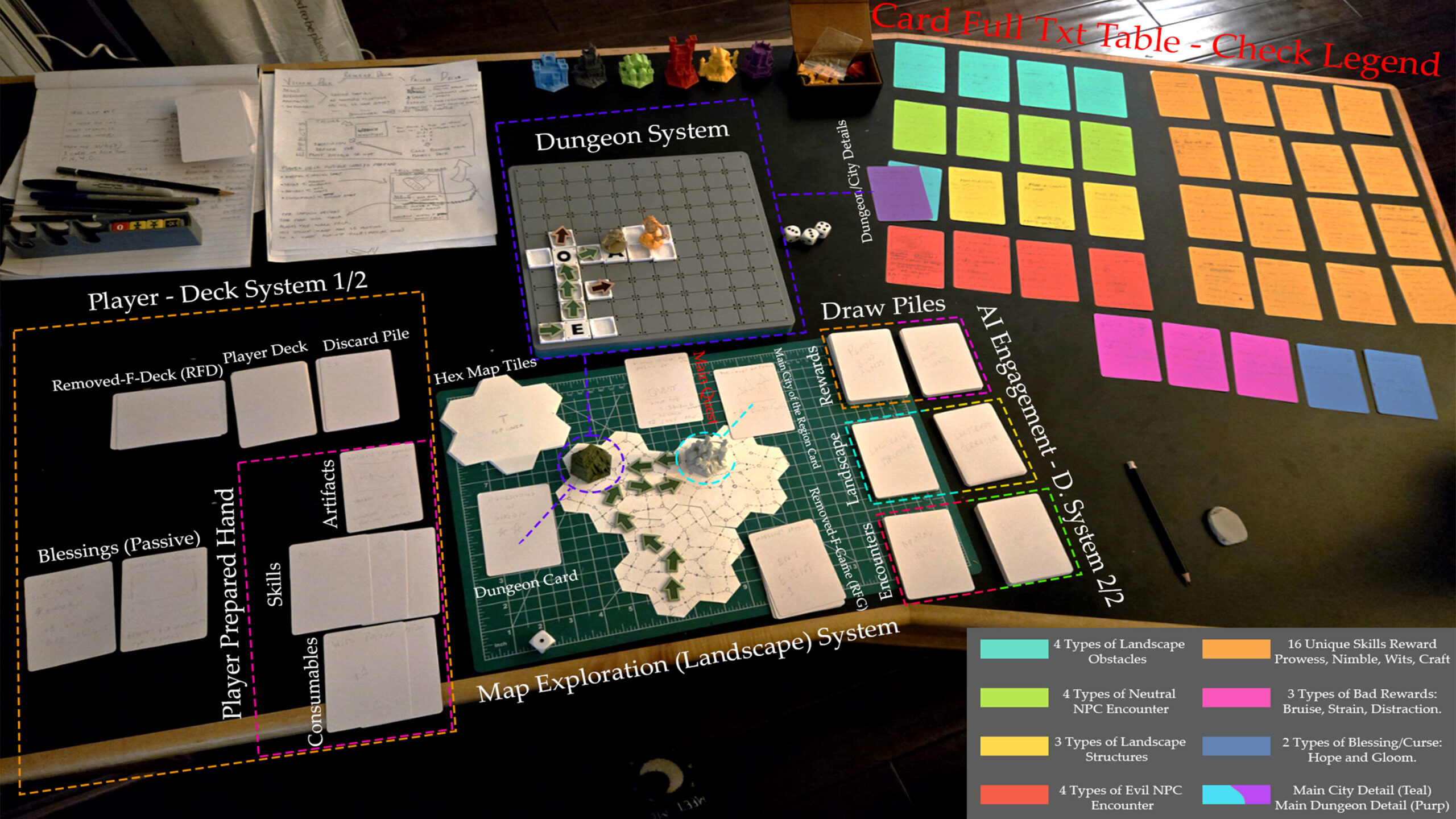
Rule Premises: To condense mechanics that would resemble the mechanics of the Exploration, Dungeon Crawl, & Combat of a cRPG, I used:

  • Deckbuilding-exhaustion systems: As progression/health for players. All interaction and mechanics are drawn from AI decks as well.
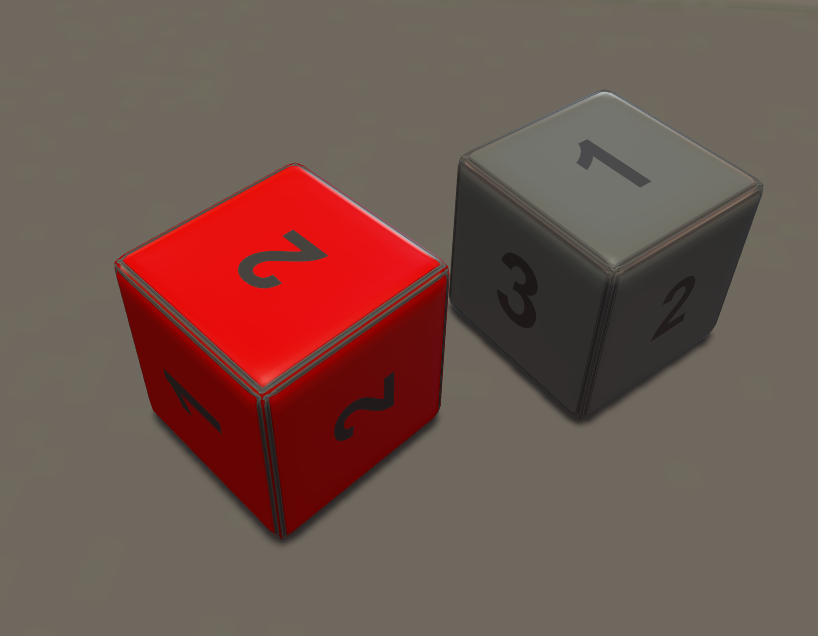
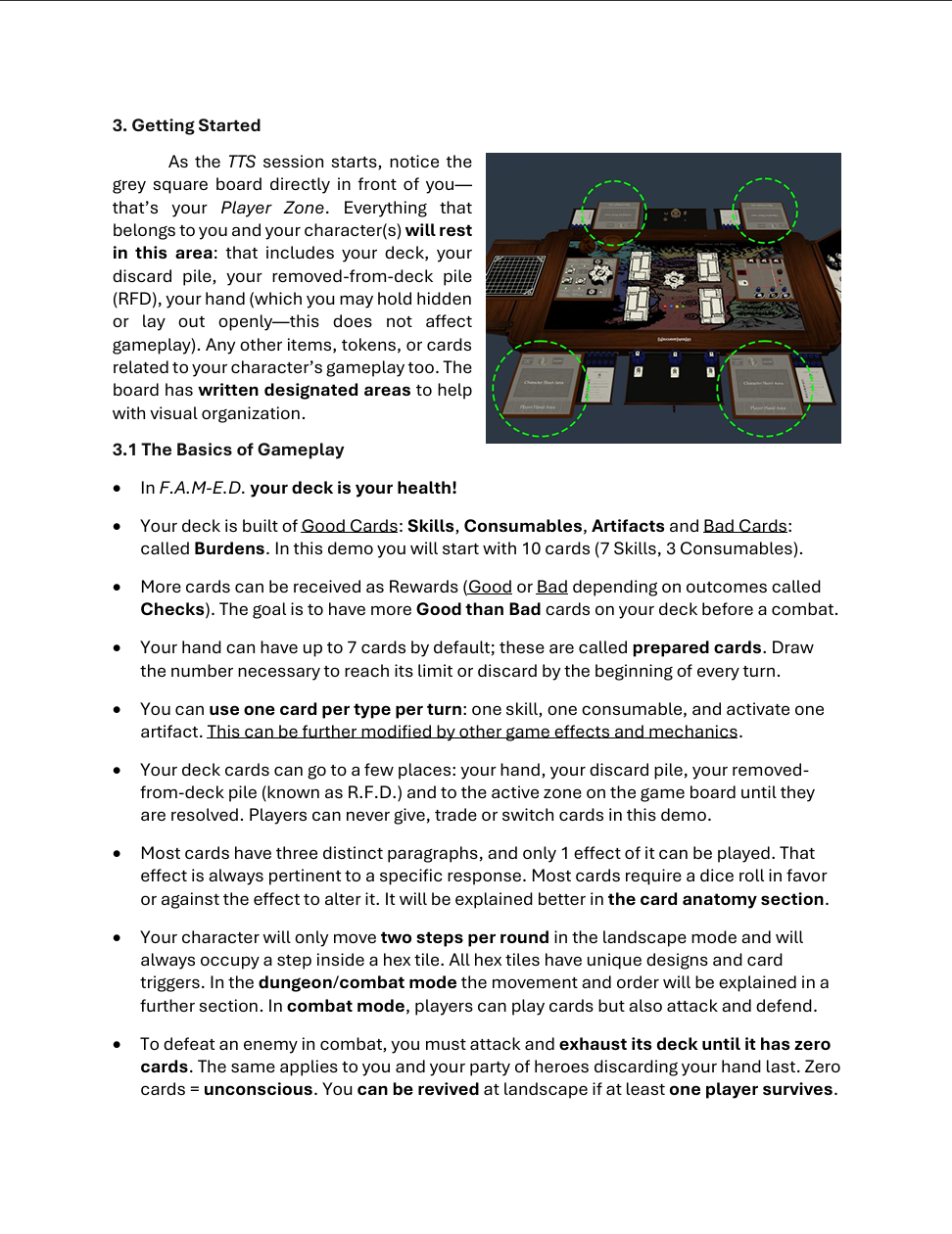
  • Two-Tier Dice systems: As secondary to card mechanics, it uses D6 for triggers, checks, and other rolls, with customized D6 for combat.
  • Two-Tier Tile systems: Represent randomly generated environments differently for Landscape (Hex) and Dungeon (Square) movement.
  • Heritage, role, and stat system: Gives each player the feeling of character building and progression, all implied for non-RPG players.
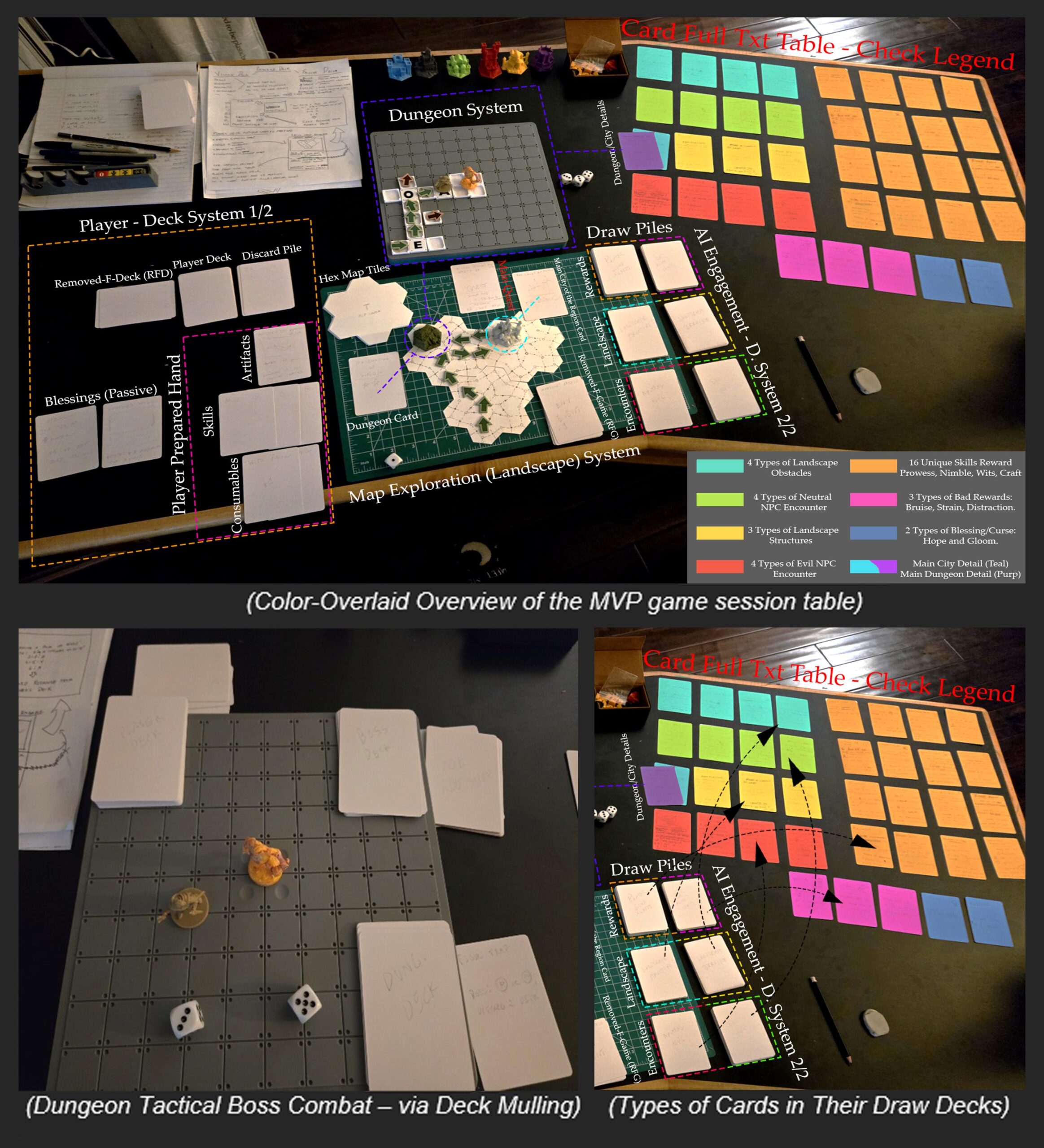
  • Small dual-play mode sessions: Splitting the game between a Landscape mode and Dungeon mode—all in small sessions—allowed the larger world map and depth to be built procedurally over multiple iterations without affecting how the players can choose to play.

Thematics: Because the game thematically and inherently requires heavy progression, character customization, and other complex mechanics that would be too exhaustive for quick player absorption—and being F.A.M-E.D. aimed at serious and casual players alike—I concluded that a simpler card-roll mechanism paired with gameplay sliced into small sessions, could give the players enough fantasy, mechanical depth, and agency to decide to play further progressions of their stories or just enjoy the fun of individual sessions at their pacing.

3. Prototyping

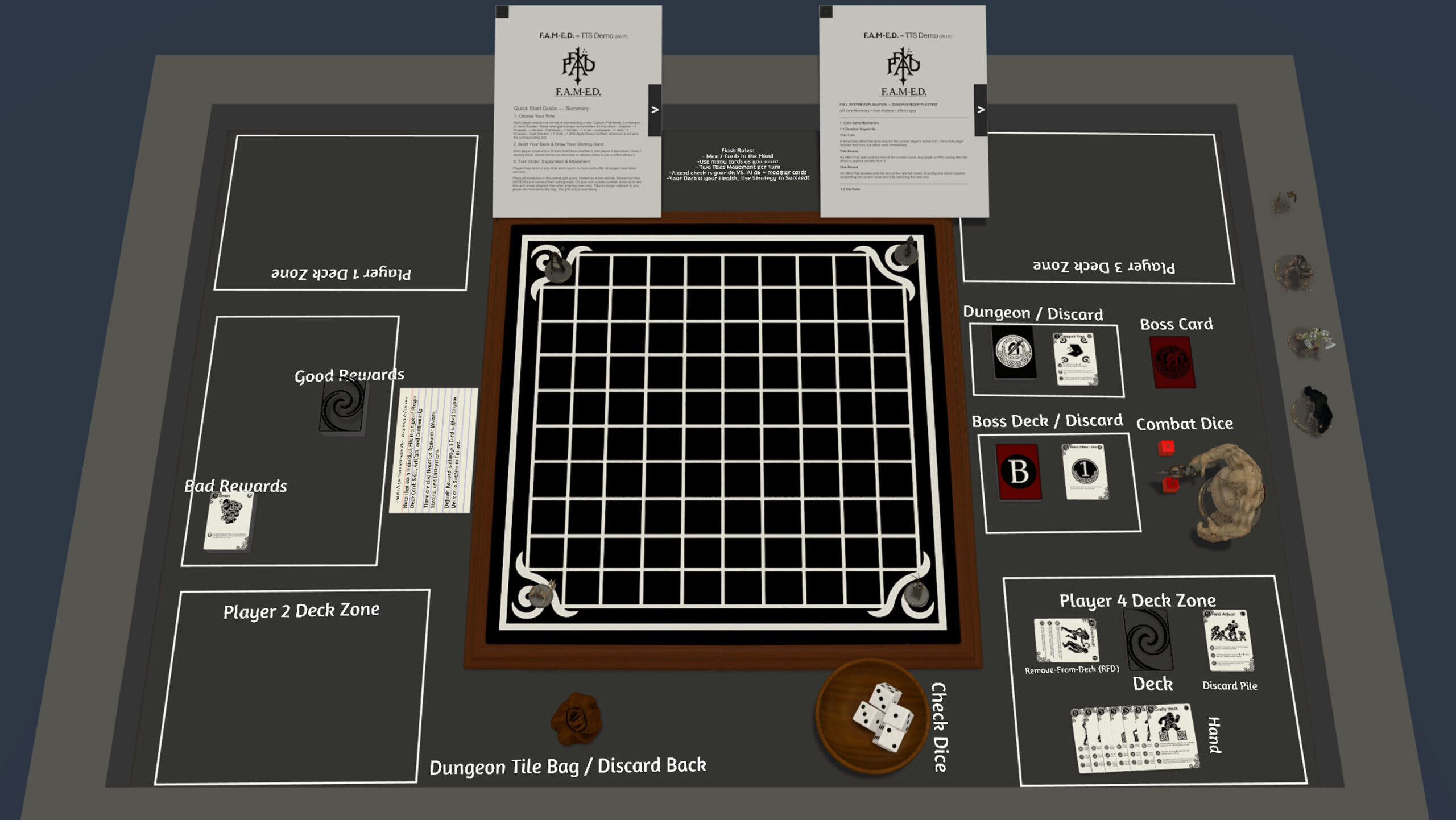
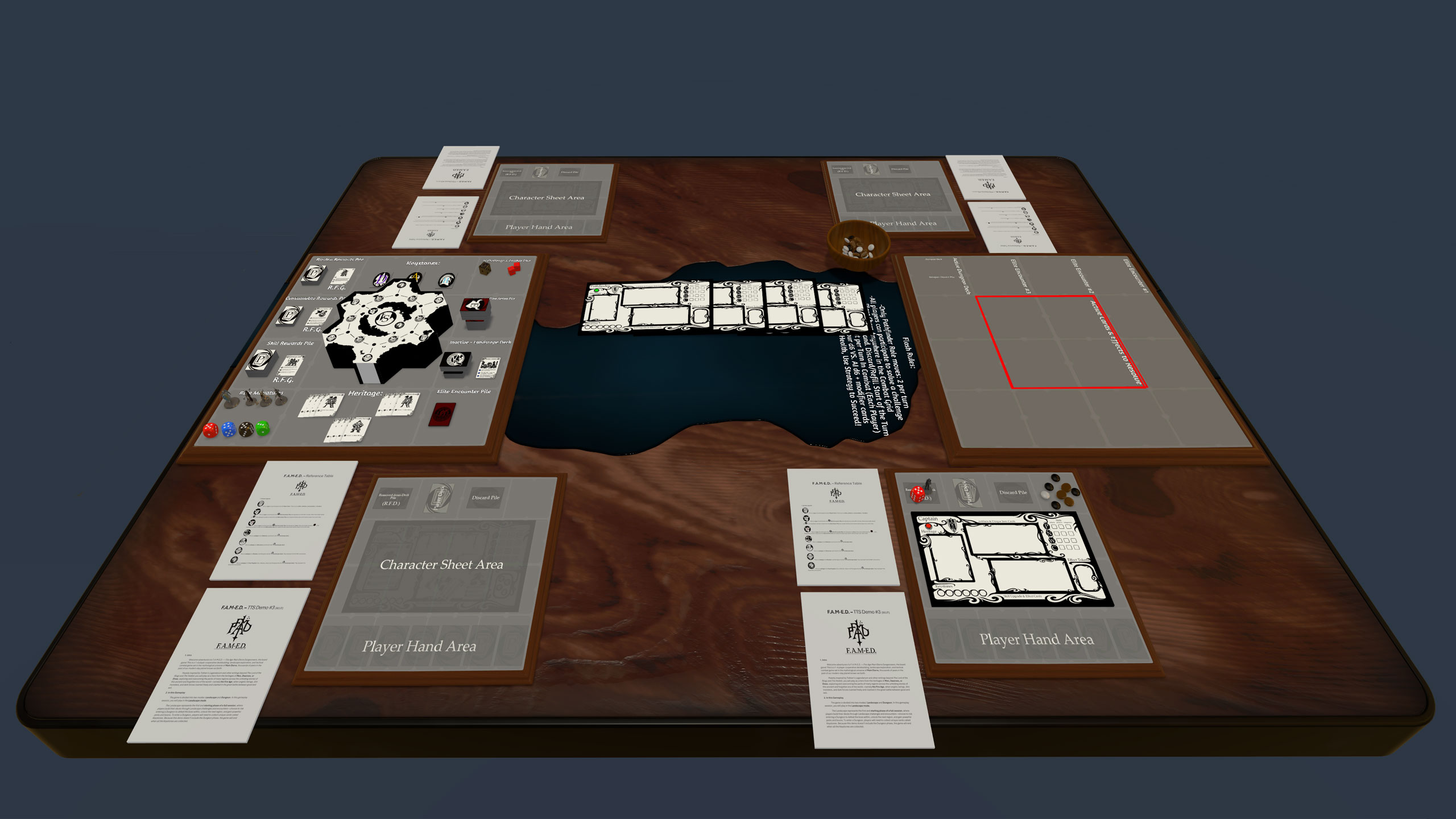
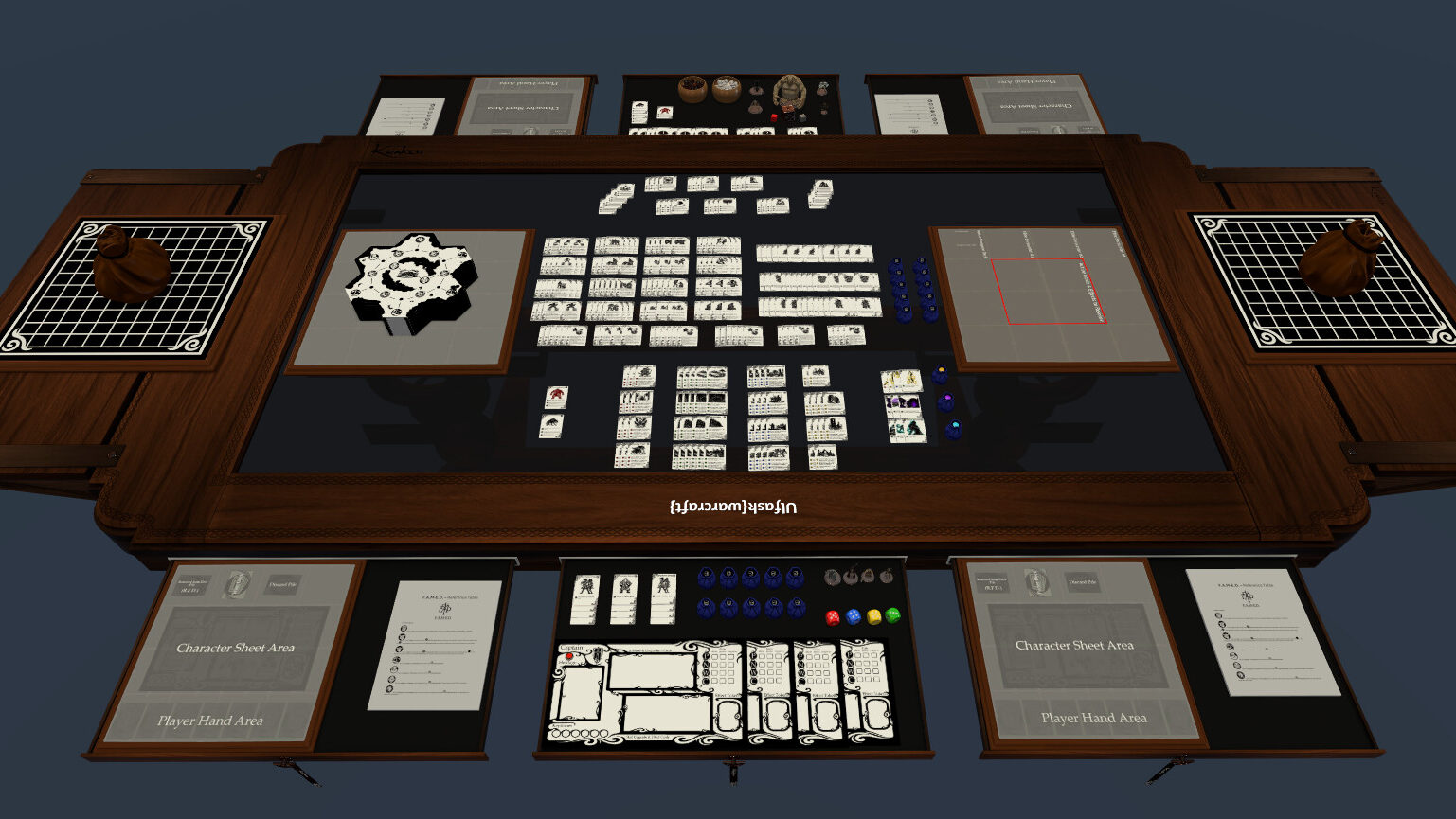
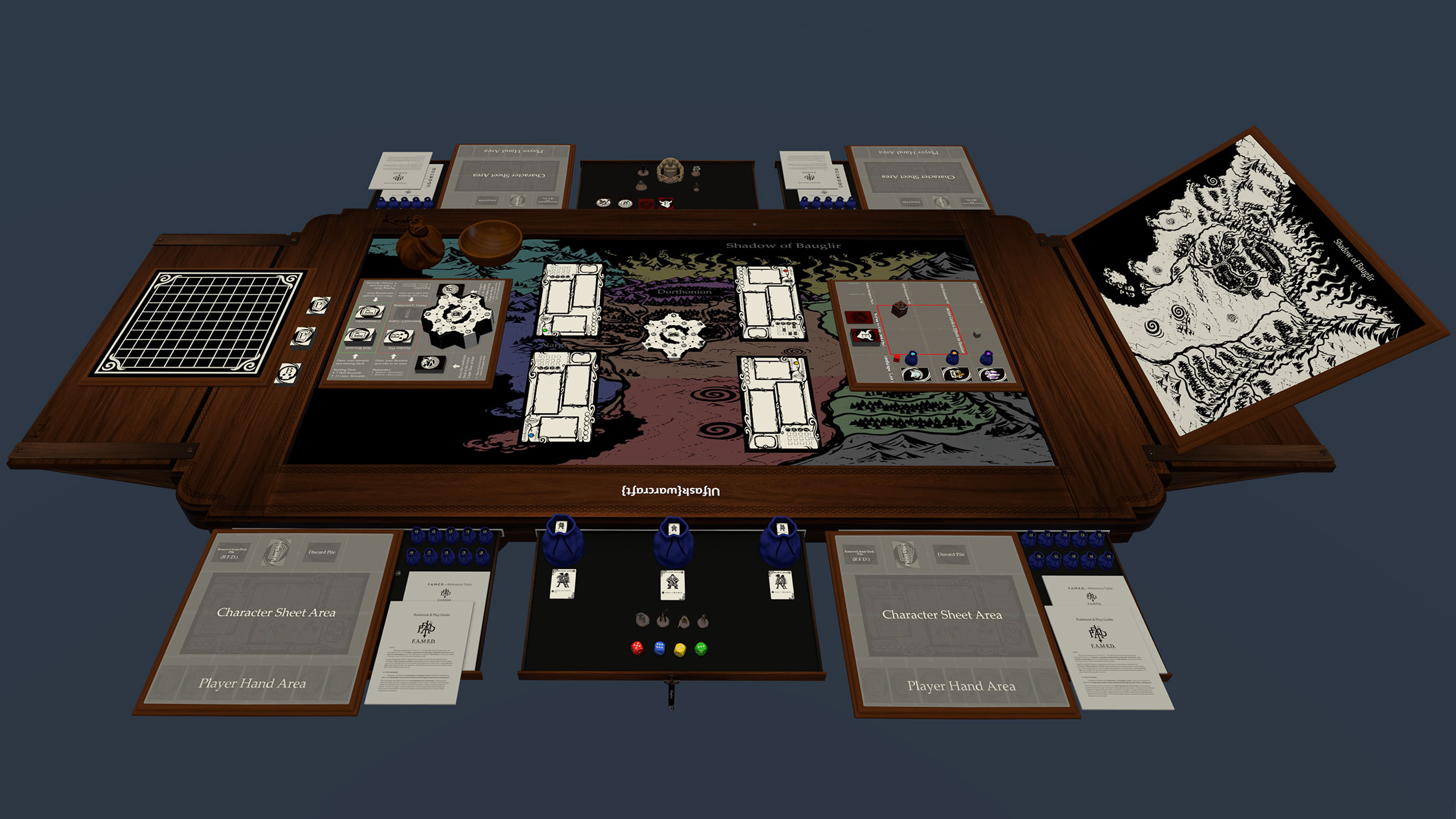
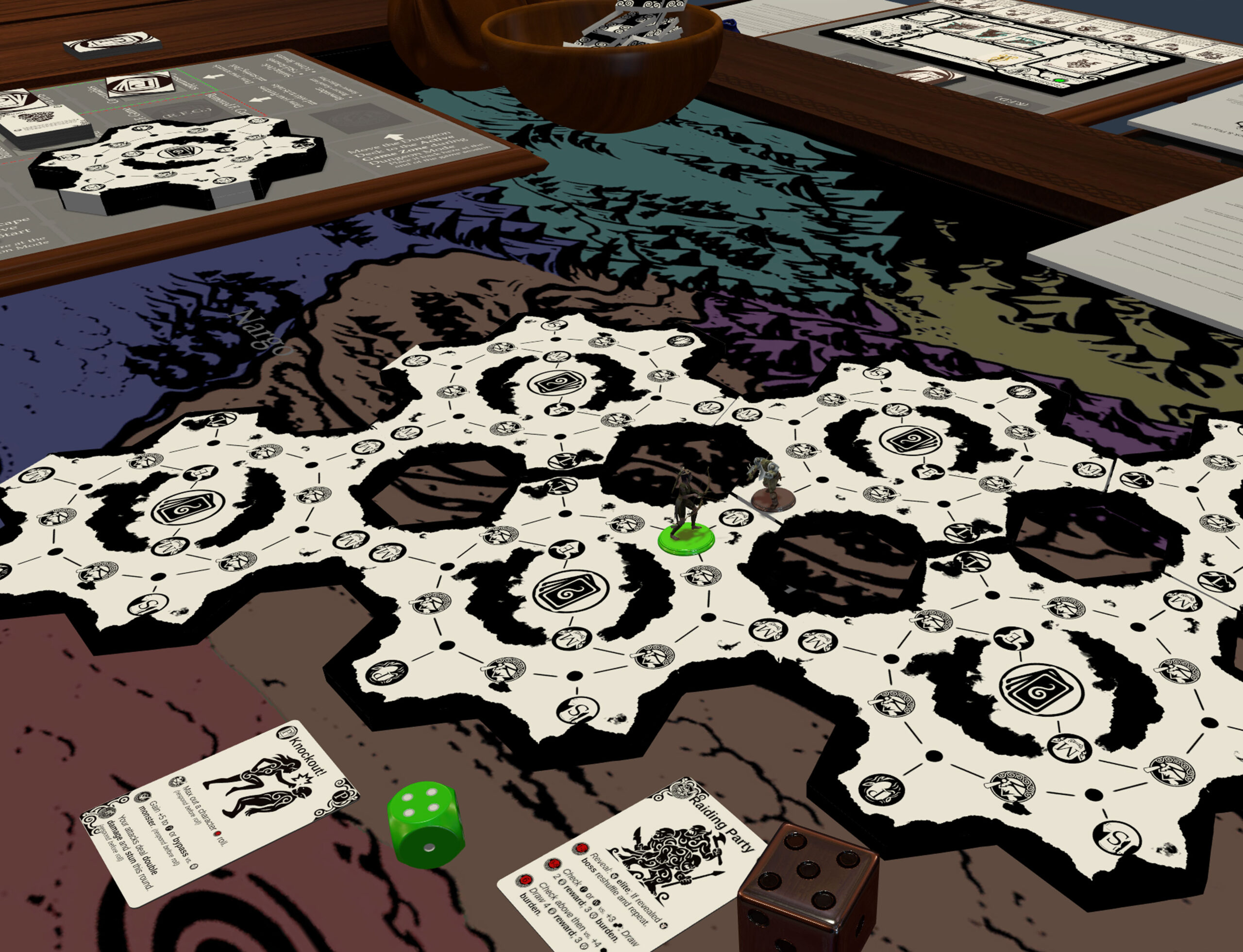
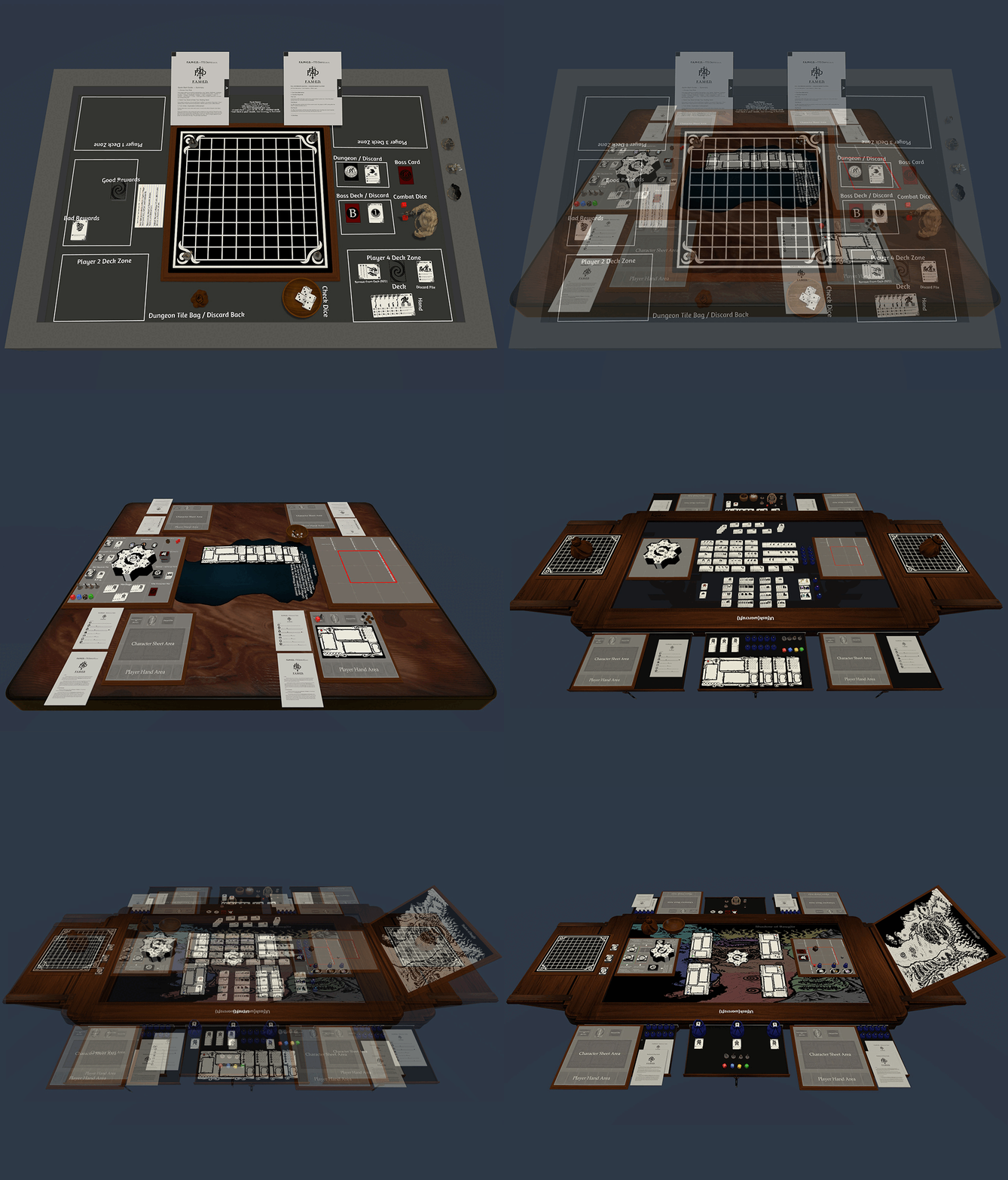
4. The In-Engine Interactables

Result:
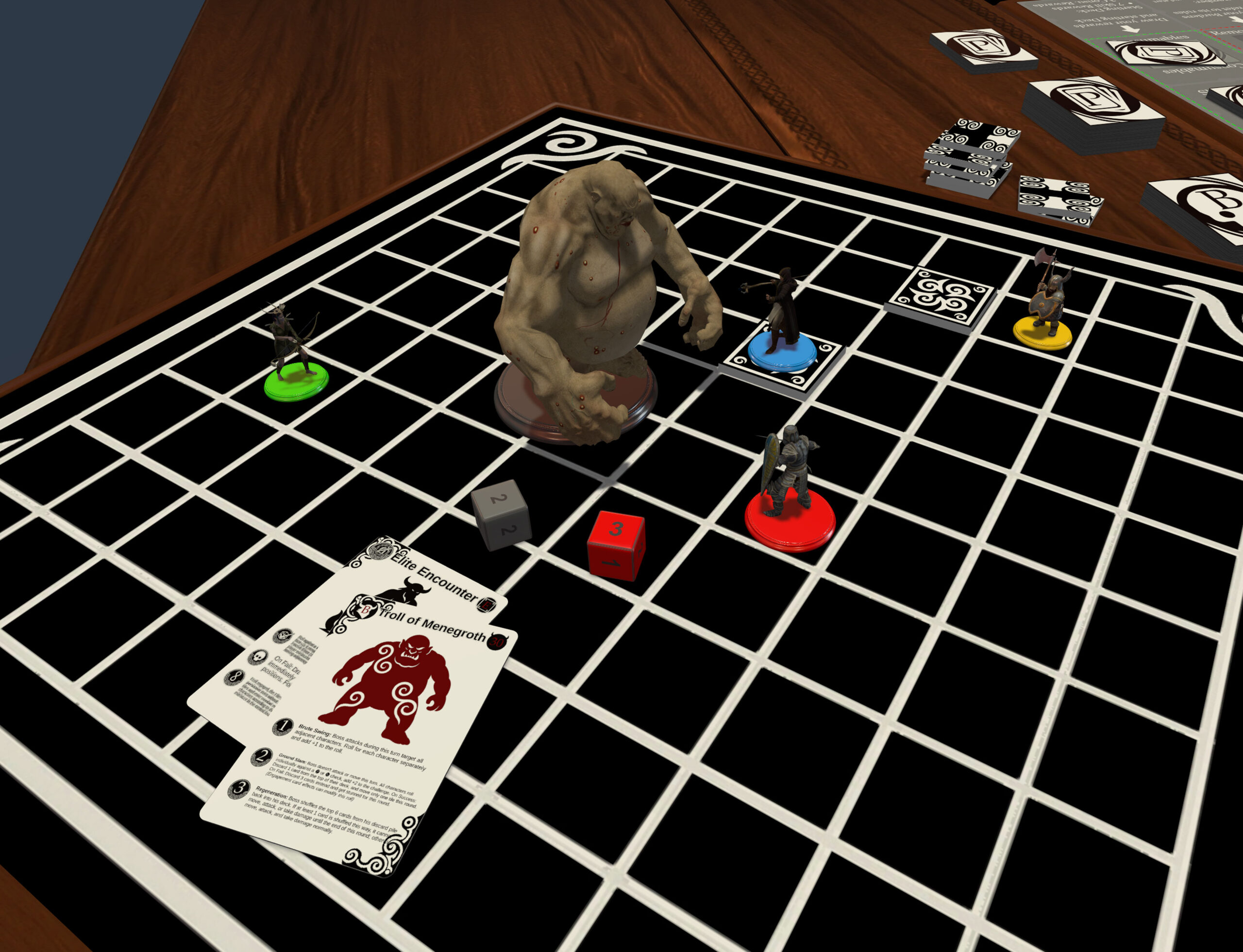
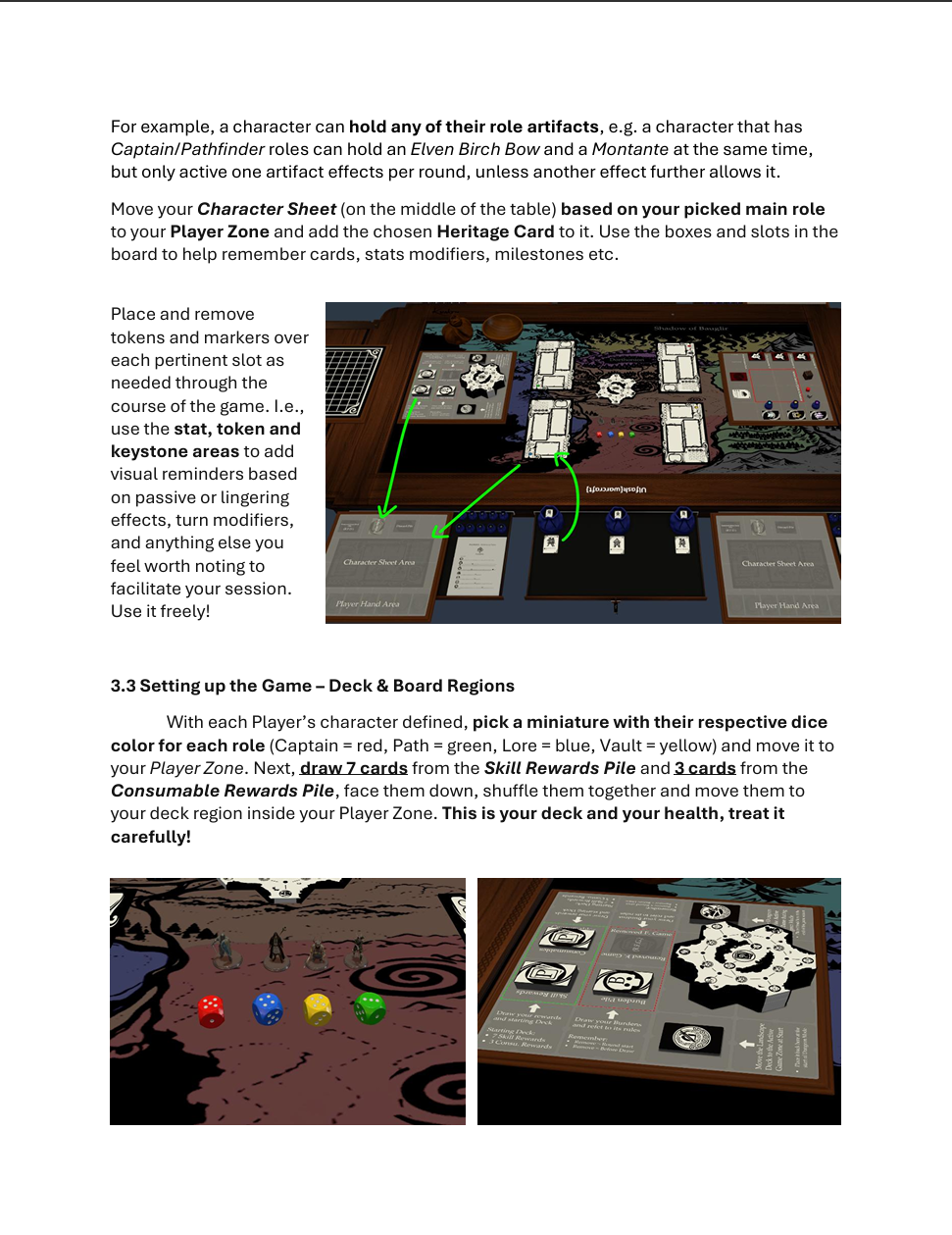
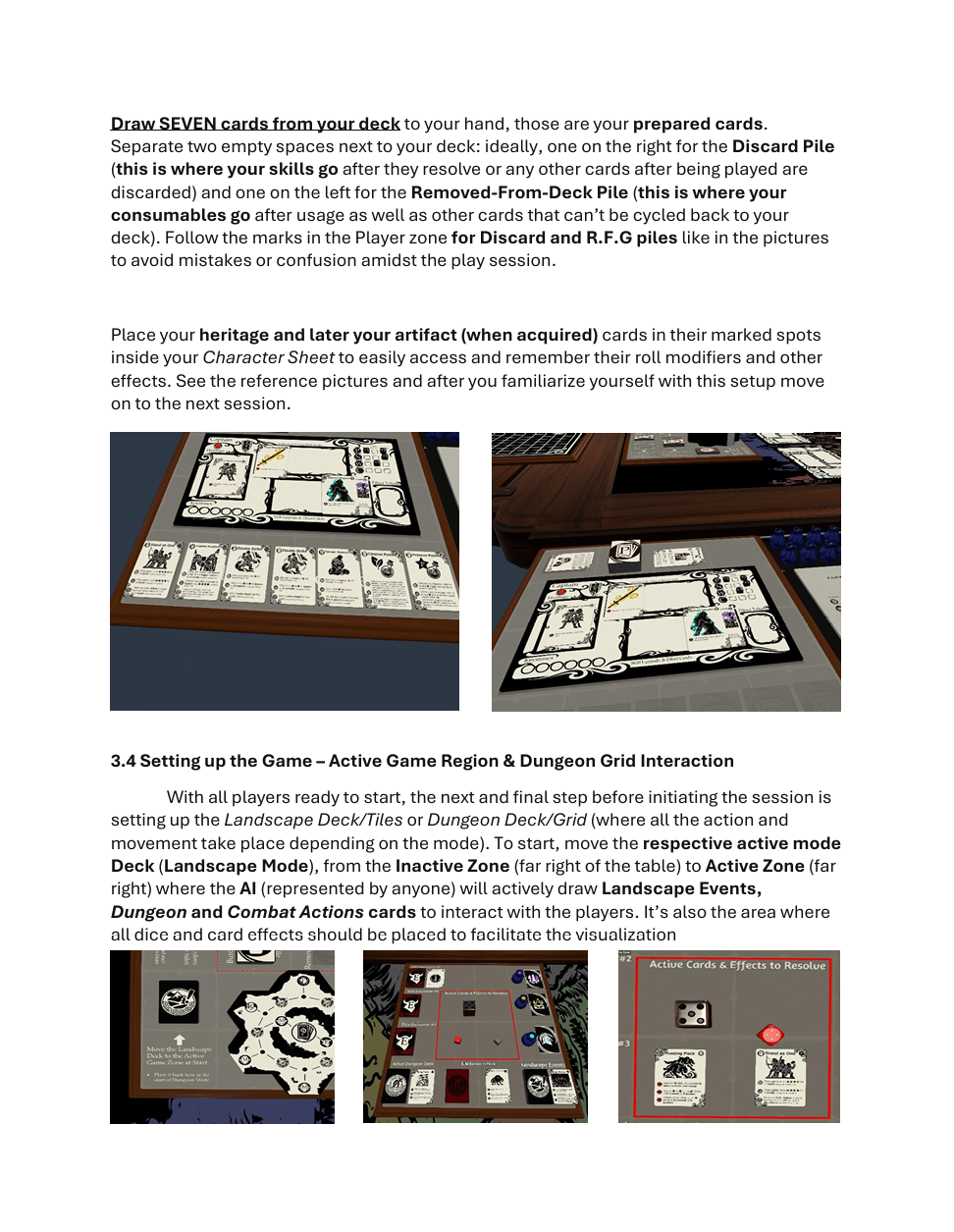
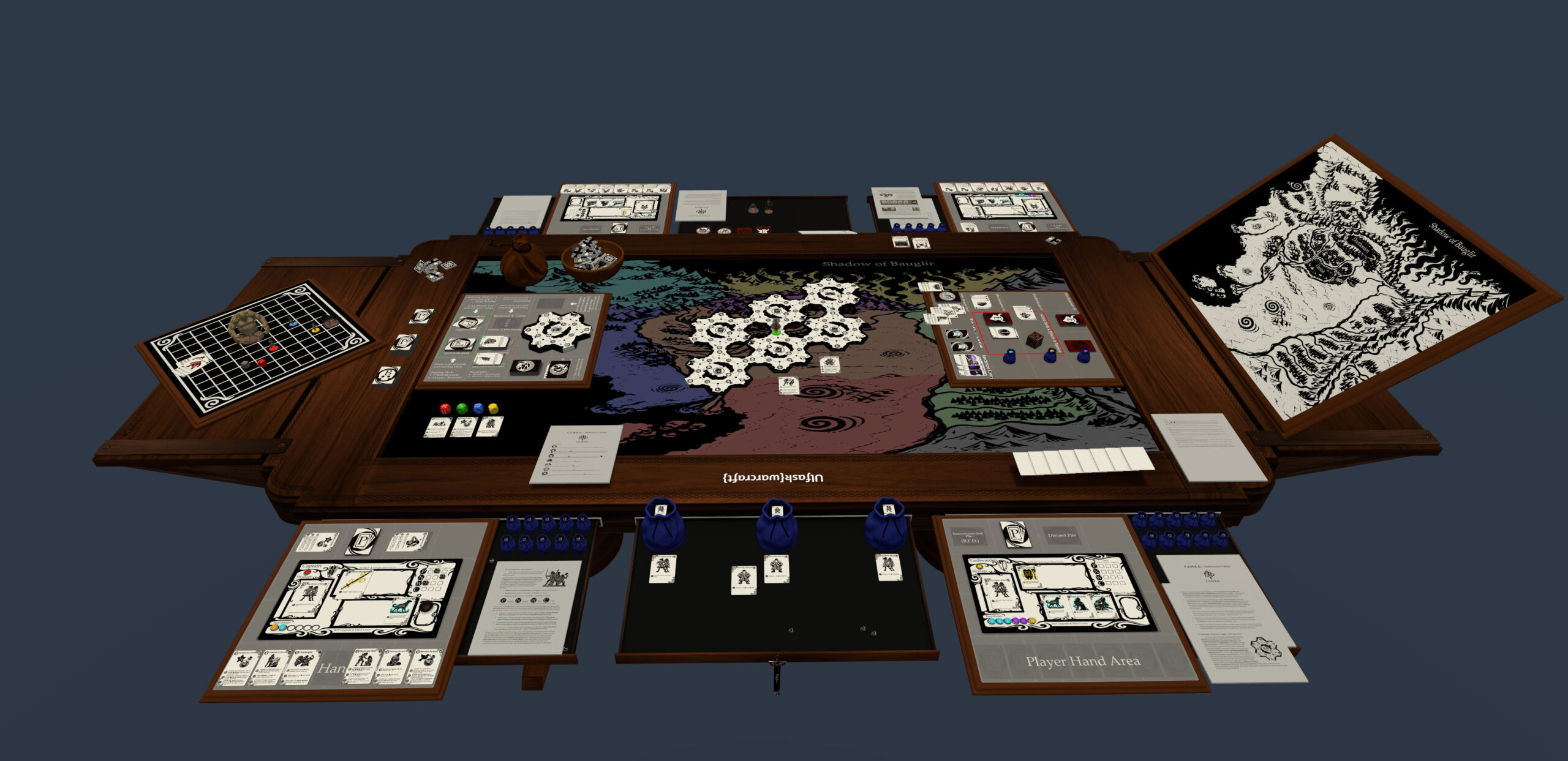
Integrated the developed game assets into Tabletop Simulator and playtested the individual mechanics and synergies with one another.
Goal:
Live feedback while iterating back-and-forth to improve player experience.
Implementation:
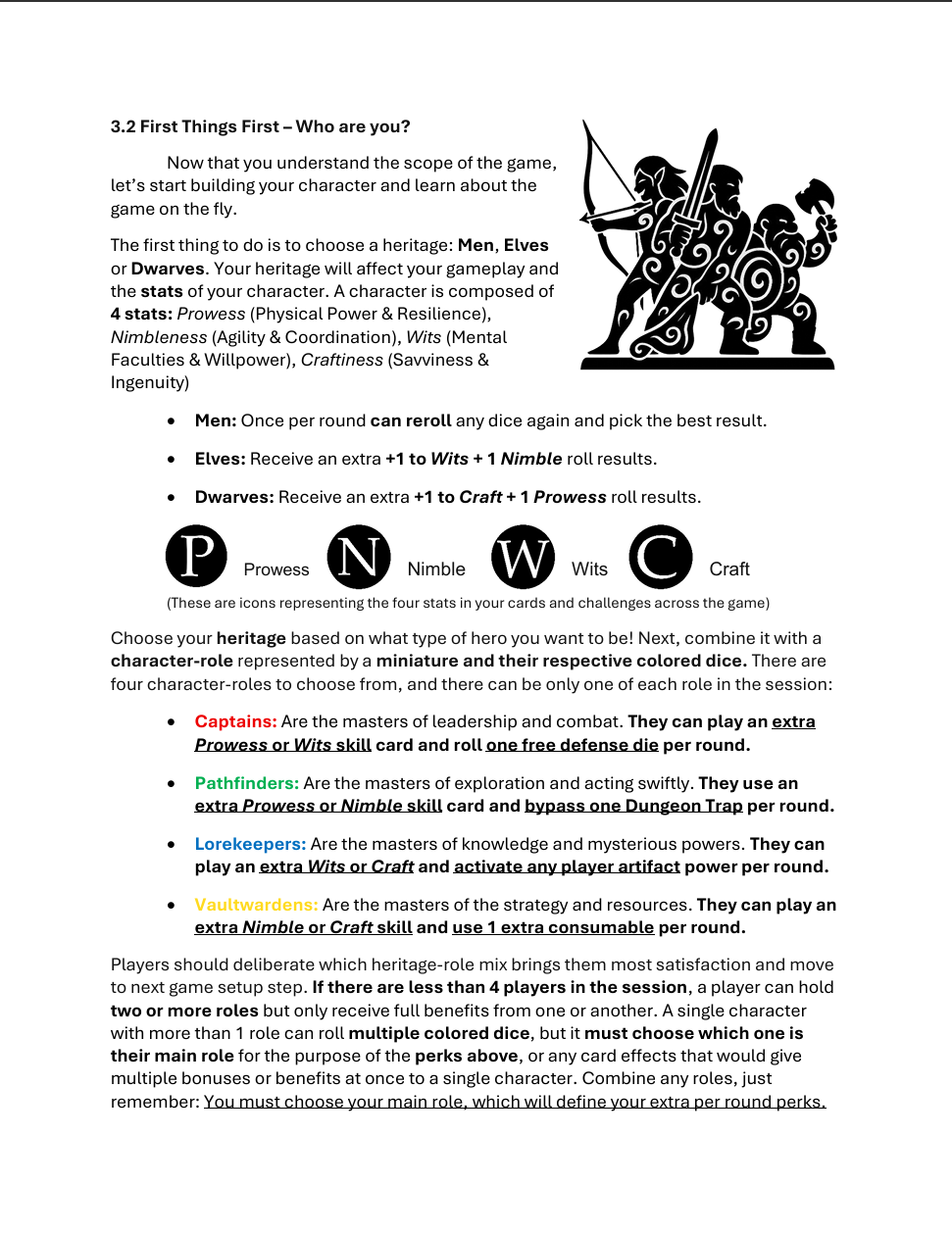
  • Mechanic Synergy: Deck-building risk-reward rolls, role-driven land events, and dungeon exploration systems reinforce each other through the game.
  • Systemic Synergy: Landscape, dungeon, and combat modes operate as a 3-chained session loop. Outputs of one become inputs of the next.
  • Ludonarrative Synergy: Story advances through a linear temporal chain that teaches the world to players via choice and consequence. Character identity and implied lore are synchronized with mechanical outcomes.

5: Playtest & Key Iterations

Playtest #1 Highlight

Result:
Players cleared the session and fought the Boss successfully; the Dungeon mode worked objectively, but it needed some tweaks to feel more meaningful.
Feedback & Problem:
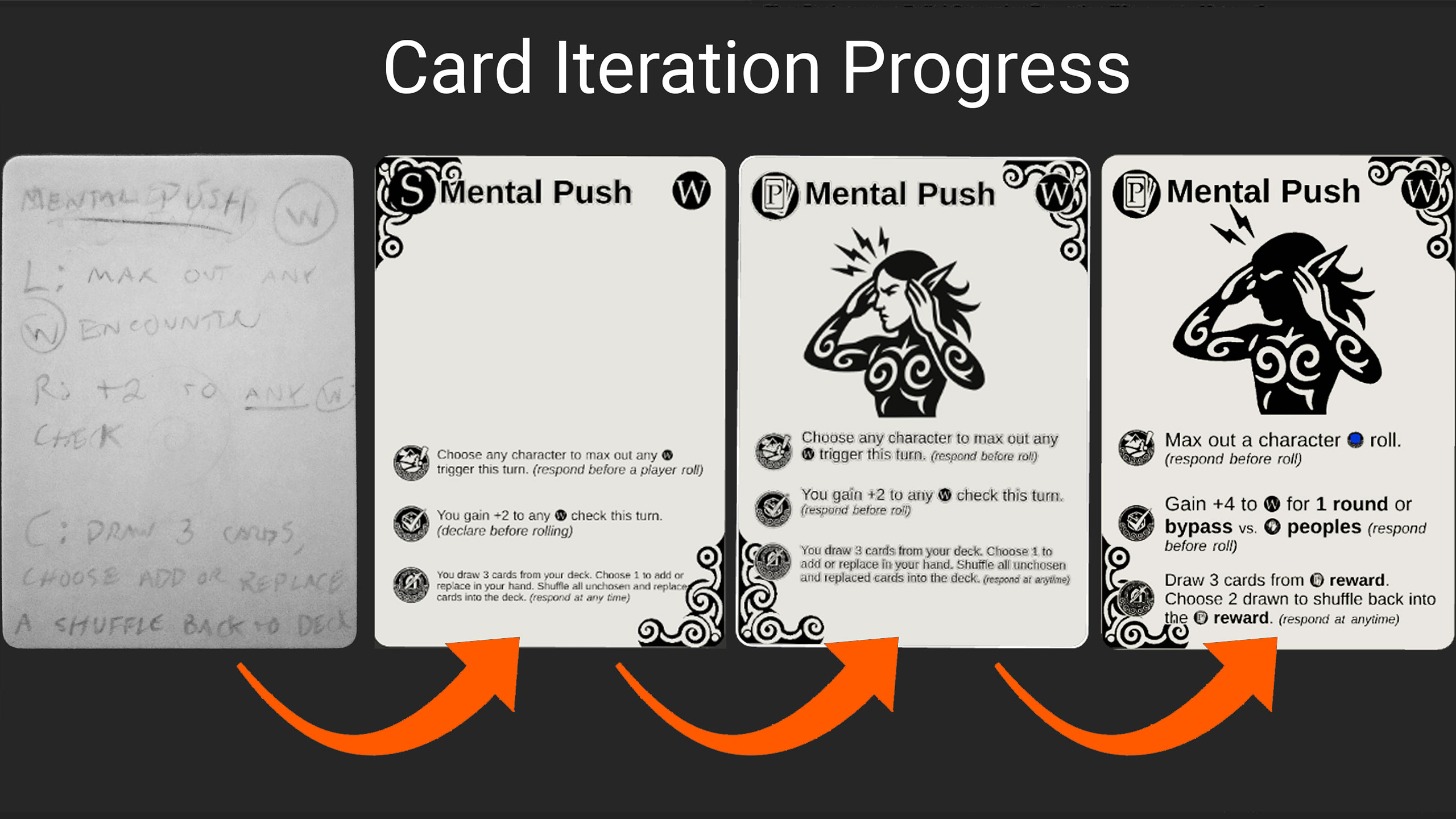
There were too many interactions per turn. Players had difficulty understanding the mechanics upfront because of similar icons, colors, and text blocks.
Solutions:
  • Added subtle colors to the designs and improved cards visual language.
  • Reworked the text mechanics readability with better in-text legends.
  • Reduced Dungeon events; increased Boss power to improve game flow.

Playtest #2 Highlight

Result:
Players cleared the session and fought the Boss successfully; the Dungeon mode worked objectively, but it needed further tweaks to feel.
Feedback & Problem:
There were too many interactions per turn. Players had difficulty understanding the mechanics upfront because of similar icons, colors, and text blocks.
Solutions:
  • Added subtle colors to the designs and reworked the cards’ visua
  • Reworked the text to improve mechanics readability and added in-text
  • Reduced Dungeon events; increased Boss power to improve game flow.

Playtest #3 Highlight

Result:
Players cleared the session and fought the Boss successfully; the Dungeon mode worked objectively, but it needed further tweaks to feel more
Feedback & Problem:
There were too many interactions per turn. Players had difficulty understanding the mechanics upfront because of similar icons, colors, and text blocks.
Solutions:
  • Added subtle colors to the designs and reworked the cards’ visual 
  • Reworked the text to improve mechanics readability and added in-text
  • Reduced Dungeon events; increased Boss power to improve game flow.

6. Polished Portfolio Piece

Results:
Reached a playable MVP build in Tabletop Simulator where the landscape exploration, dungeon crawl, and boss fight could run together in a single session loop.

Goal:
Launch and confirm that the core systems built during prototyping and playtests could function together as a complete MVP.

Execution:
  • Brought Landscape Mode and Dungeon Mode into the same playable session.
  • Integrated deckbuilding progression, dice checks, and card interactions into one system flow.
  • Aligned the hex landscape movement and square dungeon movement with encounter pacing.
  • Organized the table layout, decks, and player zones for clearer cooperative play.
  • Adjusted the boss encounter and dungeon events